
Power outages used to mean lighting candles and waiting. But in 2026, homeowners and businesses have a smarter option: battery energy storage systems that keep the lights on, the fridge running, and your life uninterrupted. Whether you're tired of blackouts, looking to cut electricity bills, or dreaming of true energy independence, battery and storage technology has matured into a reliable, cost-effective solution.
The conversation around energy storage has shifted from "why bother?" to "which system fits my needs?" With solar panels dropping in price and grid reliability becoming less predictable, battery power storage has evolved from a niche off-grid luxury into mainstream infrastructure. From compact portable power stations that fit in your trunk to whole-home systems that can run your property for days, the options have never been more diverse, or more confusing.
This guide cuts through the marketing buzzwords and technical jargon to give you a clear understanding of how battery storage works, what technologies are available, and how to choose the right system for your specific situation. Whether you're a homeowner planning your first solar-plus-storage project, an installer evaluating products for clients, or a business seeking resilient backup power, you'll find practical insights to make informed decisions.
Key Takeaways
- Battery and storage systems transform from luxury to essential infrastructure, providing backup power during outages while reducing electricity costs through peak shaving and time-of-use optimization.
- Modern battery energy storage systems respond to grid fluctuations in under 150 milliseconds, making renewable integration practical by smoothing out solar and wind variability.
- LiFePO4 (lithium iron phosphate) batteries deliver 4,000 to 6,000+ cycles with exceptional safety and longevity, making them the gold standard for residential battery and storage applications.
- Proper system sizing requires calculating both capacity (kWh) and power (kW) based on daily usage and essential loads, with professional installation and UL 9540 certification ensuring safety and performance.
- Battery storage unlocks full solar value by storing excess midday generation worth $0.02-0.05/kWh and displacing expensive evening grid power costing $0.25-0.40/kWh.
- Emerging technologies like solid-state batteries and AI-optimized energy management systems promise 50-100% higher energy density and 15-25% improved financial returns within the next 2-3 years.
What Is Battery Energy Storage and Why Does It Matter?
At its core, a battery energy storage system (BESS) captures electrical energy from sources like solar panels, wind turbines, or the utility grid, stores it in rechargeable batteries, and releases it when you need it most. Think of it as a strategic energy reservoir, charging when power is abundant or cheap, then discharging during peak demand, outages, or when your solar panels aren't producing.
The "why does it matter" part has become increasingly urgent. Grid infrastructure in many regions is aging, extreme weather events are more frequent, and utility rates keep climbing. Battery storage addresses all three challenges simultaneously. When storms knock out power lines, your battery keeps critical systems running. When electricity rates spike during summer afternoons, your stored energy shields you from premium pricing. And when your rooftop solar generates more than you can use at noon, batteries bank that excess instead of sending it back to the grid for pennies.
Beyond individual benefits, widespread battery adoption strengthens the entire power ecosystem. BESS can respond to grid fluctuations in under 150 milliseconds, far faster than traditional power plants, helping stabilize frequency and voltage. This speed makes renewable integration practical at scale, since batteries smooth out the inherent variability of solar and wind generation. In essence, energy storage transforms intermittent renewables into dispatchable, reliable power sources.
For off-grid properties, the equation is even simpler: battery storage isn't a nice-to-have feature, it's essential infrastructure. Without it, you're dependent on generator runtime or forced to match your energy use to production in real-time. With it, you gain the flexibility to live normally while still embracing energy independence.
How Battery Power Storage Systems Work
Understanding the basics of how these systems operate helps demystify what happens between charging and discharge. It's not magic, it's clever chemistry and power electronics working in concert.
Core Components of Energy Storage Systems
Every functional battery storage system relies on four main building blocks working together:
Battery modules form the heart of the system. Modern residential and commercial units typically use lithium-ion chemistry arranged in modular enclosures. Each module contains multiple cells connected in series and parallel to achieve the desired voltage and capacity. The entire battery assembly sits within enclosures equipped with thermal management, fans, heat sinks, or liquid cooling, to maintain optimal operating temperatures and extend lifespan.
Battery Management Systems (BMS) act as the vigilant guardian of your investment. The BMS continuously monitors voltage, current, and temperature across individual cells and modules. It prevents overcharging, over-discharging, and thermal runaway scenarios that could damage cells or create safety risks. Advanced BMS units track state of charge (SoC) and state of health (SoH), providing accurate predictions of available capacity and remaining service life.
Power Conversion Systems (PCS), often called bidirectional inverters, handle the translation between DC battery storage and AC household/grid power. During charging, the inverter converts AC to DC: during discharge, it flips the process. This bidirectional capability is what allows seamless integration with both solar arrays (which produce DC) and grid connections (which deliver AC).
Energy Management Systems (EMS) coordinate the entire operation. The EMS decides when to charge, when to discharge, how much power to draw or deliver, and how to prioritize different energy sources. Modern EMS platforms can integrate weather forecasts, time-of-use rate schedules, and historical usage patterns to optimize performance automatically.
Integration With Solar, Grid, and Generator Sources
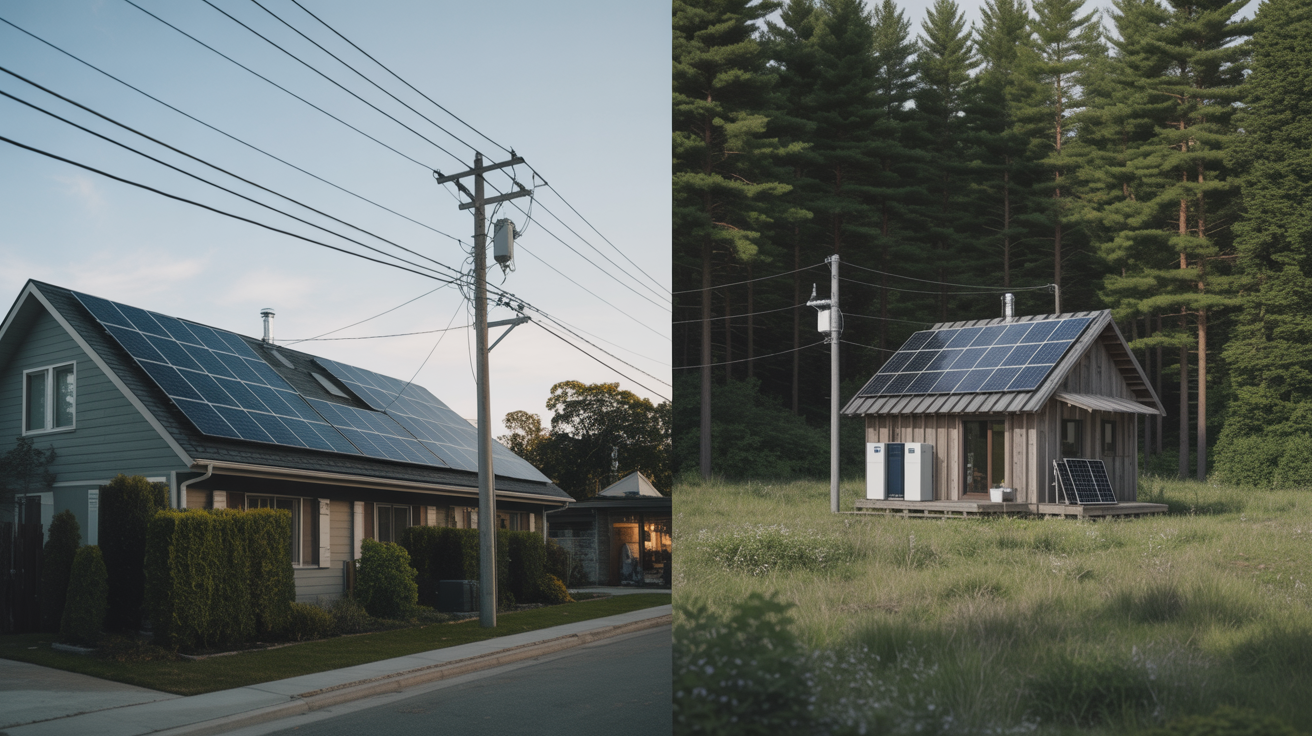
The real power of battery storage emerges when you connect multiple energy sources. With solar integration, your panels charge the batteries during sunny hours. Any excess after filling the batteries can export to the grid (if you're grid-tied) or curtail (if you're off-grid and fully charged). When the sun sets or clouds roll in, the battery seamlessly takes over, supplying stored energy without any interruption you'd notice.
Grid-tied systems offer additional flexibility. You can charge from the grid during off-peak hours when rates are lowest, then discharge during peak rate periods, a strategy called peak shaving that can dramatically reduce electricity costs. During outages, systems with backup capability automatically island your home, disconnecting from the grid and running your critical loads from battery reserves.
Generator integration creates the ultimate resilience. If your battery depletes during an extended outage, the system can automatically start a backup generator to recharge the batteries and power loads simultaneously. This hybrid approach means you run the generator far less often than you would without batteries, saving fuel, reducing noise, and extending generator life. Companies like Humless have specialized in these multi-source integrations since 2010, perfecting the coordination between solar, grid, and generator inputs for truly seamless operation.
Types of Battery Storage Technologies
Not all batteries are created equal, and the chemistry you choose has real-world implications for safety, longevity, cost, and performance.
LiFePO4 vs. Other Lithium Battery Chemistries
Lithium iron phosphate (LiFePO4 or LFP) has become the gold standard for residential and commercial battery storage, and for good reason. LFP cells offer exceptional thermal stability, they're significantly less prone to thermal runaway than other lithium chemistries. This inherent safety advantage means fewer fire risks and simpler thermal management requirements.
Cycle life is another area where LFP excels. Quality LiFePO4 batteries routinely deliver 4,000 to 6,000+ cycles at 80% depth of discharge, translating to 10-15 years of daily cycling in real-world use. Compare that to nickel manganese cobalt (NMC) batteries, which typically offer 1,000-3,000 cycles. Yes, NMC batteries pack more energy into the same space, their energy density is about 30% higher, but for stationary storage where space isn't as constrained as it is in electric vehicles, LFP's longevity and safety often matter more.
The tradeoff? LFP batteries are bulkier and heavier for the same capacity. In a home installation, that rarely matters. But it's why electric vehicles targeting maximum range often still choose NMC even though the safety and longevity compromises.
Beyond lithium, lead carbon batteries offer a budget-friendly option for grid-scale applications. They combine traditional lead-acid reliability with carbon additives that dramatically improve charge/discharge rates. They're heavier and have shorter lifespans than lithium, but for large-scale installations where cost per kWh matters most, they remain competitive.
Flow batteries, particularly vanadium redox systems, shine in very large installations. They store energy in liquid electrolytes held in external tanks, making capacity scaling as simple as adding bigger tanks. Their cycle life can exceed 20,000 cycles with minimal degradation. The downside? High upfront costs and complexity that make them impractical for most residential applications.
Solid-state batteries represent the exciting future. By replacing liquid electrolytes with solid materials, they promise higher energy density, faster charging, and even better safety than current lithium technologies. But as of 2026, they remain largely in the lab and early prototype phases, commercially available solid-state home storage systems are still a few years out.
Portable Power Stations vs. Whole-Home Systems
Scale matters when choosing battery storage. Portable power stations pack typically 500Wh to 3kWh into wheeled or handled cases you can move around. They're perfect for camping, tailgating, job sites, or keeping a few essentials running during short outages. Most include built-in inverters, multiple outlet types, and simple plug-and-play operation. The limitation? Capacity. Running a full household, refrigerator, HVAC, lights, electronics, will drain even a large portable unit in hours.
Whole-home battery systems start around 10kWh and scale upward, often in modular increments. These are professionally installed, integrated systems designed to power your entire property or selected critical circuits for extended periods. They handle much higher continuous power output, enough to run air conditioners, well pumps, and electric ranges simultaneously. Installation is more involved and costly, but the result is genuine backup capability and meaningful energy independence.
The choice between them isn't always either-or. Many homeowners start with a whole-home system for the house and add a portable unit for true mobility, taking it on trips or keeping it as a deployable resource for emergencies elsewhere.
Key Benefits of Battery Power Storage for Homeowners
Beyond the technical specs and component lists, what does battery storage actually deliver in daily life? The benefits fall into two major categories: security and economics.
Energy Independence and Backup Power Security
The visceral peace of mind that comes from storm-proofing your home can't be overstated. When severe weather rolls through and your neighbors' homes go dark, your lights stay on, your food stays cold, and your internet keeps running. For families with medical needs, CPAP machines, refrigerated medications, home medical equipment, battery backup isn't a luxury, it's a necessity.
Energy independence extends beyond outages. For off-grid properties or homes in areas with unreliable utility service, battery storage enables a lifestyle that's indistinguishable from grid-connected living. You're not rationing power or scheduling activities around generator runtime. You're living normally because your storage capacity bridges the gap between generation and consumption.
There's also a subtle but real benefit in control. You're no longer entirely at the mercy of utility decisions, rate structures, or infrastructure investments. When you generate and store your own power, you've carved out a measure of autonomy that feels increasingly valuable in an uncertain world.
Cost Savings and Peak Shaving Capabilities
The financial case for battery storage has strengthened considerably as utility rate structures evolve. Time-of-use (TOU) pricing is now standard in many markets, with peak rates 2-3 times higher than off-peak. Battery systems programmed for TOU arbitrage charge when rates are low (often overnight or midday when solar generation is high grid-wide) and discharge when rates spike.
Let's put real numbers on it: if your utility charges $0.12/kWh off-peak but $0.35/kWh during summer evening peaks, and you shift 10kWh of consumption daily from peak to off-peak, you're saving $2.30 per day, roughly $840 annually. Over a 10-15 year battery lifespan, that's $8,400-$12,600 in savings, often enough to offset a significant portion of the system cost.
For solar owners, batteries unlock the full value of your panels. Without storage, excess midday solar generation typically exports to the grid at wholesale rates (often $0.02-0.05/kWh). With storage, that same energy displaces expensive evening grid power worth $0.25-0.40/kWh. The difference transforms solar economics.
Businesses with demand charges benefit even more dramatically. Commercial rate structures often include fees based on your peak 15-minute power draw during the billing period. One brief spike, running all equipment at once, can trigger demand charges of hundreds or thousands of dollars. Battery systems shave these peaks by supplementing grid power during high-draw moments, effectively capping your maximum demand and slashing monthly bills.
Choosing the Right Battery Storage System for Your Needs
With dozens of manufacturers and hundreds of models on the market, selecting the right system can feel overwhelming. Focus on these core factors to narrow your options.
Sizing Your System: Capacity and Power Requirements
Capacity (measured in kilowatt-hours, kWh) tells you how much energy the battery stores, the size of your tank. Power (measured in kilowatts, kW) tells you how fast you can drain or fill that tank, the size of your pipe. You need both specs to match your needs.
Start with a usage analysis. Review your electric bills to find your daily consumption. A typical American home uses 25-30 kWh daily, though this varies wildly based on size, climate, and appliances. If you're sizing for backup only, focus on essential loads: refrigerator (150W), lights (200W), internet/computer (200W), HVAC (if critical, 2,000-4,000W). Sum these and multiply by the hours you want to run them to estimate required capacity.
For example, if your essential loads total 3kW and you want 8 hours of backup, you need 24kWh of capacity (3kW × 8h). But batteries shouldn't regularly discharge to 0%, it degrades them. Target 80% usable capacity means you'd actually want a 30kWh system (24 ÷ 0.8).
Power rating determines what you can run simultaneously. If your well pump draws 1.5kW, your fridge 0.2kW, and lights another 0.2kW, you need at least 2kW continuous output. Many systems can briefly surge higher, important for motor-driven appliances with high startup currents.
Don't forget future-proofing. If you might add an electric vehicle, heat pump, or more solar panels, choose a system with expansion capability. Modular designs that let you add battery capacity later offer valuable flexibility.
Safety Certifications and Standards to Look For
Battery systems store substantial energy, and poor design or quality control can create genuine hazards. Safety certifications aren't optional checkboxes, they're evidence of rigorous testing and compliance with established standards.
UL 9540 is the key certification for energy storage systems in North America. It covers the complete integrated system, batteries, inverters, enclosures, and controls, verifying electrical safety, fire resistance, and proper functionality. UL 9540 testing includes abuse scenarios like overcharging, short circuits, and thermal exposure.
UL 1973 specifically addresses battery modules and packs, covering cell-level safety and performance. Many quality systems carry both certifications.
For grid-tied systems, look for UL 1741 SA (or SB) certification, which verifies grid-interactive inverter capabilities and ensures the system safely disconnects during outages to protect utility workers.
Beyond certifications, investigate the manufacturer's track record. How long have they been in business? Companies like Humless, with 15+ years specializing in energy storage, bring experience that newer entrants simply can't match. Check warranty terms, quality systems typically include 10-year warranties covering both defects and capacity retention (often warranted above 70-80% of original capacity at end of warranty).
Finally, verify that professional installation is included or strongly recommended. DIY battery installation might seem cost-effective, but improper setup can void warranties, create safety risks, and result in poor performance. Systems integrated by experienced professionals simply work better and last longer.
Installation and Maintenance Considerations
Getting your battery system installed correctly sets the foundation for years of reliable service. While the specifics vary by system size and type, some general principles apply universally.
Location matters more than you might think. Battery enclosures need adequate ventilation, protection from temperature extremes, and accessibility for maintenance. Garages work well in moderate climates: conditioned spaces are ideal in very hot or cold regions. Outdoor-rated enclosures solve space constraints but may require additional weatherproofing and temperature management.
Electrical integration requires professional expertise. The installer will add circuits, breakers, and potentially a critical loads subpanel if you're backing up only essential circuits. Grid-tied systems need properly configured disconnect switches and anti-islanding protection. Off-grid installations require careful coordination between solar charge controllers, battery inputs, and generator automatic transfer switches.
Permitting and utility interconnection can add weeks to the timeline. Most jurisdictions require electrical permits for battery installations: grid-tied systems need utility approval before activation. An experienced installer handles this paperwork and knows local requirements, saving you substantial headaches.
Maintenance for modern lithium systems is refreshingly minimal. There's no watering, no acid checks, no terminal cleaning like lead-acid batteries required. But that doesn't mean zero attention. Schedule annual inspections to verify connections remain tight, check for any error codes on the EMS, and confirm the BMS reports healthy cell balance. Many systems include remote monitoring that alerts you to issues before they become problems.
Keep battery enclosures clean and ensure ventilation paths remain unobstructed. If your system includes active cooling (fans or pumps), verify they're operating. Monitor performance through the system app or display, if you notice unusual discharge rates or reduced capacity, investigate promptly.
Firmware updates occasionally roll out with performance improvements or bug fixes. Some systems update automatically via internet connection: others require manual initiation. Stay current to ensure optimal performance and compatibility with evolving grid requirements.
Thermal management deserves special attention in extreme climates. Lithium batteries perform best between 50-85°F. Consistent exposure above 95°F accelerates degradation: operation below freezing reduces available capacity and can damage cells if charged too quickly. If you're in a climate with temperature extremes, invest in properly rated enclosures with active thermal management.
The Future of Battery and Storage Technology
Battery storage in 2026 is mature and reliable, but exciting developments are reshaping what's possible in the near future.
Solid-state batteries remain the most anticipated breakthrough. By replacing flammable liquid electrolytes with solid ceramic or polymer materials, solid-state designs promise 50-100% higher energy density than current lithium-ion while virtually eliminating fire risk. Several manufacturers have demonstrated working prototypes, with residential products expected to reach the market within 2-3 years. When they arrive, expect smaller, lighter systems with longer lifespans, though initially at premium prices.
Higher DC voltage architectures are gaining traction. Traditional residential systems operate at 48V DC, but 400V and even 800V systems are emerging. Higher voltages reduce current for the same power, allowing smaller wiring, lower resistive losses, and more efficient operation. The transition requires compatible components throughout the system, but early adopters are seeing efficiency gains of 2-4%, meaningful over decades of operation.
Grid integration is becoming more sophisticated. Virtual power plants (VPPs) aggregate thousands of home battery systems into distributed resources that utilities can call upon during peak demand. Participants earn payments for making their batteries available, creating a new revenue stream that improves payback periods. Several states now have active VPP programs, and expansion is accelerating.
Artificial intelligence and machine learning are optimizing battery performance in real-time. Modern EMS platforms don't just follow simple rules, they learn your usage patterns, predict needs, integrate weather forecasts, and dynamically adjust charging/discharging strategies to maximize savings and resilience. The difference between a basic time-of-use schedule and an AI-optimized system can add 15-25% to financial returns.
Recycling and second-life applications are maturing as early battery systems reach end-of-life. Batteries retired from demanding automotive service often retain 70-80% capacity, insufficient for vehicles but perfectly adequate for stationary storage. This second-life market offers lower-cost entry points for storage. Simultaneously, recycling processes now recover 90%+ of valuable materials like lithium, cobalt, and nickel, reducing environmental impact and resource dependency.
The trajectory is clear: battery storage will become cheaper, denser, safer, and smarter. What's already a compelling value proposition today will only strengthen in the years ahead, making now an excellent time to evaluate whether energy storage fits your situation.
Conclusion
Battery and storage technology has crossed the threshold from emerging innovation to essential infrastructure. Whether your primary motivation is backup security, cost savings, environmental responsibility, or energy independence, today's systems deliver tangible value with proven reliability.
The journey from curiosity to installation doesn't have to be complicated. Start by assessing your needs, daily energy use, critical backup loads, and future plans. Research systems that match your requirements, prioritizing safety certifications and established manufacturers with strong support networks. And work with experienced installers who understand both the technical integration and the permitting landscape in your area.
The energy landscape is shifting beneath our feet. Grid reliability faces growing challenges while renewable generation expands rapidly. Battery storage sits at the intersection of these trends, enabling individuals and businesses to take control of their energy future. The systems available today are sophisticated, safe, and cost-effective, light years beyond what was possible even five years ago.
For those ready to explore what battery power storage can do for their property, partnering with experienced specialists makes all the difference. Humless has been pioneering battery energy storage systems since 2010, offering comprehensive solutions backed by 24/7 support and proven reliability across thousands of installations. Whether you're designing a whole-home backup system, integrating with existing solar, or planning off-grid independence, the right storage solution is out there, and the benefits start the day it goes live.
Frequently Asked Questions About Battery and Storage
What is a battery energy storage system and how does it work?
A battery energy storage system (BESS) captures electrical energy from solar panels, wind turbines, or the grid, stores it in rechargeable batteries, and releases it during outages, peak demand, or when renewable sources aren't producing. It uses bidirectional inverters to convert between DC and AC power, with battery management systems ensuring safe, optimized operation.
Why is LiFePO4 the preferred battery chemistry for home energy storage?
Lithium iron phosphate (LiFePO4 or LFP) offers exceptional thermal stability and safety, with significantly lower fire risk than other lithium chemistries. It delivers 4,000-6,000+ cycles at 80% depth of discharge, translating to 10-15 years of daily use, making it ideal for residential battery storage applications.
How much money can battery storage save on electricity bills?
Battery storage enables time-of-use arbitrage by charging during low-rate periods and discharging during peak rates. If you shift 10kWh daily from peak rates ($0.35/kWh) to off-peak ($0.12/kWh), you can save approximately $840 annually, or $8,400-$12,600 over a 10-15 year battery lifespan.
What size battery storage system do I need for my home?
Size your system based on daily energy consumption and backup needs. A typical home uses 25-30 kWh daily. For backup, calculate essential loads (refrigerator, lights, internet) and multiply by desired runtime hours. Target 80% usable capacity, so for 24kWh backup needs, choose a 30kWh system.
What safety certifications should I look for in a battery storage system?
Look for UL 9540 certification, which covers complete integrated systems including batteries, inverters, and controls for electrical safety and fire resistance. UL 1973 certifies battery modules specifically, while UL 1741 SA/SB verifies grid-interactive inverter safety. These certifications ensure rigorous testing and compliance with established standards.
Can battery storage systems respond fast enough to stabilize the grid?
Yes, battery energy storage systems can respond to grid fluctuations in under 150 milliseconds, far faster than traditional power plants. This rapid response capability helps stabilize grid frequency and voltage, making large-scale renewable energy integration practical by smoothing out the variability of solar and wind generation.