
There's something deeply satisfying about harvesting energy from the sun. But here's the catch: solar panels only work when the sun's shining. The moment clouds roll in or evening falls, you're back to relying on the grid, unless you've got a battery backup system. That's where solar battery storage changes the game entirely.
If you've invested thousands into a solar array, watching surplus energy get sent back to the grid for pennies on the dollar feels like leaving money on the table. Worse, when storms knock out power, your solar panels shut down for safety reasons, leaving you in the dark even though all that potential on your roof. Battery backup solves both problems: it stores your excess solar energy for use when you actually need it and keeps critical systems running during outages. Whether you're a homeowner chasing energy independence, a solar installer designing resilient systems, or a business owner managing peak demand costs, understanding battery backup technology is essential for maximizing your solar investment.
Key Takeaways
- Battery backup for solar stores excess energy generated during the day for use at night or during outages, maximizing your solar investment.
- Modern LiFePO4 batteries offer 12-15 year lifespans with 4,000-6,000 charge cycles and superior safety compared to other chemistries.
- AC-coupled battery systems retrofit easily onto existing solar installations, while DC-coupled systems offer 94-96% efficiency for new builds.
- Properly sized residential battery backup typically ranges from 10-20 kWh for essential loads and can eliminate reliance on the grid during power outages.
- Solar battery backup enables cost savings through time-of-use rate arbitrage and demand charge reduction while providing energy independence.
- Choosing certified systems with UL 9540 ratings and working with experienced installers ensures safety and maximizes long-term performance.
What Is Battery Backup for Solar?
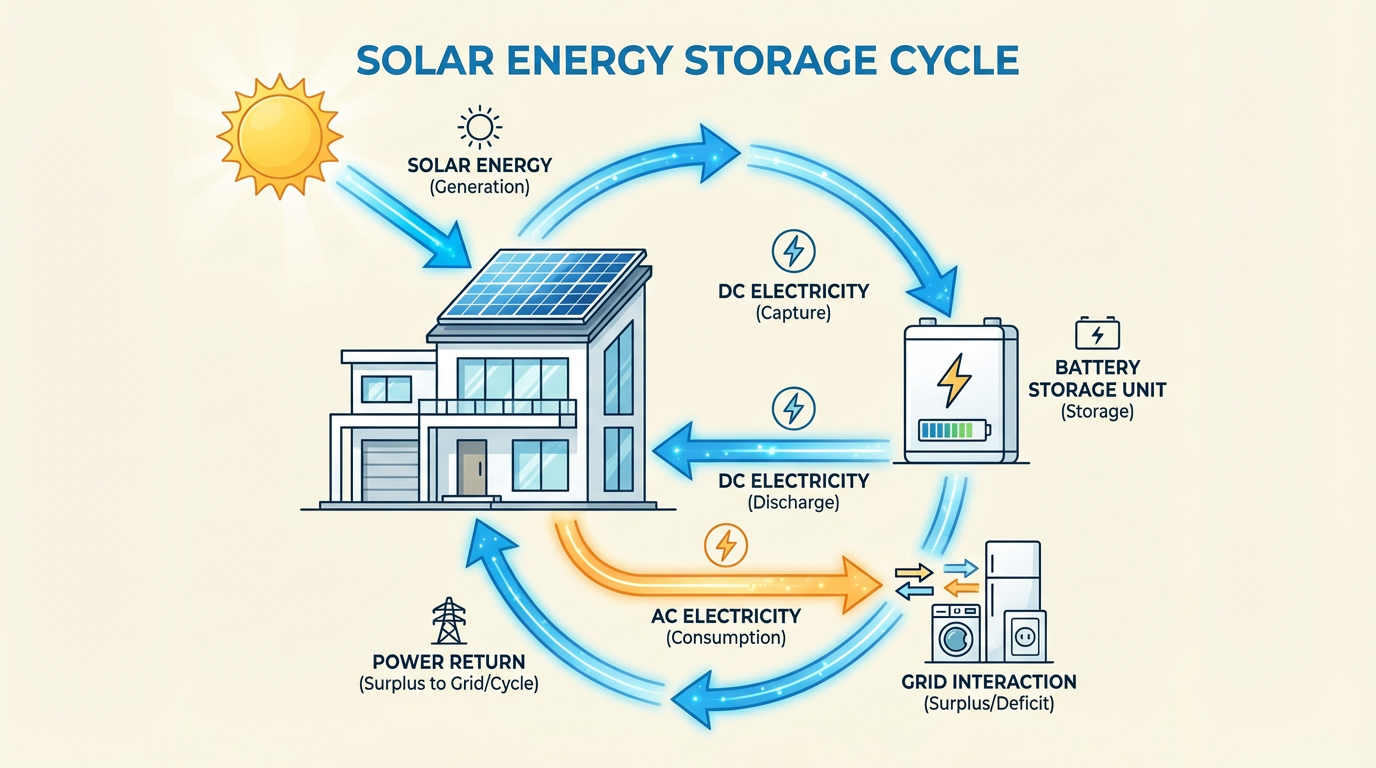
At its core, solar battery backup is a system that captures and stores the excess electricity your solar panels generate during daylight hours. Instead of automatically feeding every unused watt back to the utility grid, the system diverts that surplus energy into battery banks where it sits ready for deployment, at night, during cloudy stretches, or when the power grid fails.
Think of it as a savings account for electricity. Your solar panels might generate 40 kWh on a sunny summer day, but your home only consumes 25 kWh during those peak production hours. Without storage, that extra 15 kWh typically flows back to the grid under net metering agreements (often earning you credit at wholesale rates rather than the retail price you pay). With battery backup, you bank that energy for evening use when your panels are dormant but your home is fully active.
The technology itself has evolved dramatically. While lead-acid batteries dominated early off-grid systems, modern residential installations overwhelmingly favor lithium-ion chemistries, particularly LiFePO4 (lithium iron phosphate), for their superior efficiency, compact footprint, and significantly longer cycle life. These batteries can charge and discharge thousands of times over 10-15 years without substantial degradation, making them practical for daily use rather than just emergency backup.
The distinction matters because solar battery backup isn't just about keeping the lights on during storms. It's about fundamentally changing your relationship with energy: shifting from passive grid consumer to active energy manager who controls when and how electricity gets used.
How Solar Battery Backup Systems Work
Understanding the energy flow in a battery backup system reveals why these setups are so versatile. Modern systems follow a clear hierarchy that prioritizes efficiency and maximizes your solar investment.
Integration with Solar Panels
The integration architecture makes all the difference in system performance. You've got two primary approaches, each with distinct trade-offs.
DC-coupled systems create a direct connection between your solar panels and batteries through a charge controller, keeping electricity in its native DC (direct current) form until the final conversion to AC (alternating current) for home use. This approach achieves 94-96% round-trip efficiency because you're only converting once. The downside? Installation complexity is higher, requiring careful coordination of components and typically works best when designing a complete system from scratch.
AC-coupled systems take a different route. Solar electricity converts to AC through your existing inverter, then converts back to DC for battery storage through a separate battery inverter. Yes, you lose a few percentage points of efficiency (90-94%), but the payoff is flexibility. These systems retrofit beautifully onto existing solar installations without ripping out your current equipment or upgrading electrical panels. Plus, AC-coupled batteries can charge from any AC source, solar, grid, or generator, which opens up sophisticated energy management strategies.
For homeowners with established solar arrays who want to add storage, AC coupling is usually the path of least resistance. New installations benefit from carefully weighing efficiency gains against future flexibility.
Storage and Discharge Cycles
Once integrated, your system orchestrates a daily dance of energy movement:
- Morning through afternoon: Solar panels wake up and immediately power whatever your home demands, refrigerator, HVAC, computers, the works. Any excess production automatically diverts to charging your battery bank.
- Battery reaches full charge: If your panels are still cranking out surplus energy, the system can export it to the grid (assuming you've got net metering) or simply curtail production if you're off-grid.
- Evening arrives: As solar production tapers off, your battery seamlessly takes over, discharging stored energy to cover your home's evening and nighttime load, when electricity usage actually peaks for most households.
- Battery depletes: If you drain the batteries before sunrise (rare with properly sized systems), the grid automatically kicks in as your backup.
During power outages, the magic really happens. A backup gateway instantly detects the grid failure and isolates your home, preventing backfeed that could endanger utility workers. Your battery then powers a critical loads sub-panel, pre-selected circuits you've designated for backup like refrigerators, medical equipment, lights, and internet. Meanwhile, your solar panels continue generating, recharging batteries during the day so you can ride out multi-day outages.
AC-coupled systems shine here because they can carry out time-of-use strategies: charging batteries from cheap grid power at 2 AM, then discharging during expensive peak evening hours, all while your solar contribution layers on top.
Key Benefits of Solar Battery Backup
The case for battery backup extends well beyond the romantic notion of energy independence. Let's break down the tangible advantages that justify the investment.
Energy Independence and Grid Resilience
Here's an irony most people don't realize: if you've only got solar panels without batteries, a power outage shuts down your entire system. Utilities require this safety disconnect to protect lineworkers repairing downed lines. Your roof could be soaking up perfect sunshine while you're sitting in the dark.
Battery backup breaks that dependency. With storage, your system operates as a true hybrid, functioning as grid-tied during normal conditions but seamlessly switching to off-grid island mode during outages. You maintain power for essential systems (or your entire home, depending on capacity) regardless of what's happening on the utility side.
For families with medical equipment, home offices that can't afford downtime, or simply households tired of losing hundreds of dollars in spoiled food after every storm, this resilience carries real value. And in an era of increasingly stressed grids, whether from extreme weather, wildfire prevention shutoffs, or infrastructure aging, that value keeps climbing.
Systems from companies like Humless, which pioneered battery energy storage technology since 2010, integrate seamlessly with not just solar but also wind and generator sources, creating true energy redundancy that adapts to whatever power source is available.
Cost Savings and Peak Demand Management
The financial benefits split into immediate and long-term categories, and they're more substantial than most people expect.
Rate arbitrage becomes possible with smart battery systems. If your utility charges time-of-use rates, say, $0.12 per kWh overnight but $0.35 during 5-9 PM peak hours, you can program batteries to charge when rates are low and discharge when they're high. That differential adds up quickly, especially in states like California where peak/off-peak spreads are dramatic.
Demand charge reduction matters enormously for commercial applications. Many businesses pay not just for total energy consumed but for their peak 15-minute demand interval each month. A battery system that shaves those demand spikes can cut electric bills by 20-40%.
Net metering optimization becomes more valuable as policies shift. Many jurisdictions are reducing net metering credits or moving to less favorable rate structures. Self-consuming stored solar energy avoids these diminishing returns, ensuring you get full retail value from every kWh your panels produce.
And let's not forget the avoided cost of alternatives. A whole-home generator runs you $10,000-$20,000 installed, guzzles expensive fuel during outages, requires regular maintenance, and does absolutely nothing for your energy bills. Solar battery backup delivers resilience while actively saving money every month, a much better value proposition.
Types of Solar Battery Backup Technologies
Not all batteries are created equal, and the chemistry you choose profoundly impacts system performance, safety, and longevity. Here's what actually matters in the real world.
LiFePO4 Battery Energy Storage Systems
Lithium iron phosphate (LiFePO4) batteries have emerged as the gold standard for residential and commercial solar storage, and the reasons are compelling.
Safety tops the list. LiFePO4 chemistry is inherently thermally stable, it won't suffer thermal runaway or catastrophic failure even under abuse conditions that would torch other lithium chemistries. That stability translates to simpler installation requirements and genuine peace of mind when you've got a large energy storage system inside your home or business.
Cycle life reaches 4,000-6,000 deep discharge cycles before capacity drops to 80%, meaning these batteries can handle daily cycling for 12-15+ years. That longevity makes the higher upfront cost far more palatable when you calculate cost per cycle.
Modular design allows precise capacity matching. Need exactly 15 kWh? You can configure that. Want to start with 10 kWh and expand to 30 kWh in two years? Most LiFePO4 systems scale elegantly.
Humless has specialized in LiFePO4 battery energy storage systems since 2010, offering industry-leading 15-year warranties that reflect genuine confidence in the technology. Their AC-coupled compatibility means you can integrate with virtually any existing solar installation without wholesale system replacement. When you're looking at a 15-year product warranty backed by over 15 years of proven field reliability, the value proposition gets hard to ignore.
Other Battery Chemistries
While LiFePO4 dominates residential installations, other technologies serve specific niches worth understanding.
NMC (nickel manganese cobalt) lithium-ion batteries offer higher energy density, packing more capacity into smaller spaces. The Generac PWRcell 2, for instance, delivers 9-36 kWh modular capacity with impressive 96.5% round-trip efficiency and integrates beautifully with Generac's whole-home generators. The 10-year warranty and $12,000-$25,000 installed pricing makes these competitive, though the safety profile doesn't quite match LiFePO4's inherent stability.
Lead-acid batteries (both flooded and sealed AGM/gel variants) still appear in budget-conscious off-grid installations. They're proven, inexpensive, and recyclable. But with cycle lives under 1,000 deep discharges, constant maintenance requirements, and poor performance in partial-state-of-charge applications, they're rapidly being displaced by lithium technologies.
Saltwater batteries (like the now-defunct Aquion) promised non-toxic chemistry and infinite cycle life but struggled with low energy density and eventually couldn't compete economically.
For most applications, residential backup, daily cycling, grid-tied systems, LiFePO4 has effectively won the technology war. The combination of safety, longevity, efficiency, and increasingly competitive pricing makes it the obvious choice unless you've got very specific requirements that demand alternatives.
Choosing the Right Battery Capacity for Your Needs
Getting capacity right makes the difference between a system that delivers value and one that disappoints. Too small, and you're constantly bumping against limits: too large, and you've spent money on capacity you'll never use.
Residential Backup Power Requirements
Start with a realistic assessment of your backup priorities. Most residential systems fall into the 10-20 kWh range, though that varies wildly based on goals.
Essential loads only: If you're primarily concerned with riding out 8-12 hour outages while keeping refrigerators, a few lights, internet, and critical medical equipment running, 10-13 kWh typically suffices. Calculate your critical load, add up the wattage of everything on your backup panel and multiply by the hours you need coverage. A refrigerator draws 150W continuously, LED lights maybe 100W total, internet and computers another 200W. That's 450W, or about 11 kWh for 24 hours of coverage.
Partial home backup targeting air conditioning, most lighting, and major appliances (but not electric water heaters or dryers) generally requires 15-20 kWh. You'll maintain reasonable comfort during outages but make some conscious usage decisions.
Whole home backup means 30-40+ kWh systems that can run everything simultaneously without thought. This gets expensive quickly, figure $20,000-$40,000 for battery capacity alone, but delivers genuine energy independence and maximum resilience.
Don't forget to factor solar recharging. If you've got a 10 kW solar array generating 40 kWh on sunny days, you can support substantially larger loads during multi-day outages than if you're just draining batteries with no replenishment. That's where the solar-plus-storage combination really shines compared to generators or standalone batteries.
Commercial and Off-Grid Applications
Commercial sizing follows different logic, driven by demand charges and load profiles rather than backup duration.
Peak shaving applications might need 50-100 kWh to cut those 15-minute demand spikes that drive up monthly bills. The battery doesn't need to power your entire facility, just enough to clip the peaks during high-load events.
Off-grid residential or commercial installations require significantly larger banks, often 40-80 kWh or more, because you're covering 100% of nighttime consumption with no grid safety net. You'll also want to budget for backup generation capacity (propane or diesel) to carry you through extended cloudy periods when solar production drops by 60-80%.
Remote telecommunications or critical infrastructure demands extreme reliability, often spec'ing batteries for 72+ hours of runtime without any recharging. These systems prioritize redundancy and longevity over cost optimization.
The key is matching capacity to actual usage patterns, not theoretical maximums. Track your historical consumption data, identify your true backup needs, and size accordingly. Modular systems from manufacturers like Humless offer the flexibility to start conservatively and expand capacity as needs evolve, a smarter approach than over-building from day one.
Installation Considerations and System Integration
Even the best battery technology won't deliver value if the installation is poorly executed. Here's what separates professional installations from disasters waiting to happen.
Grid-Tied vs. Off-Grid Configurations
Your system architecture fundamentally shapes what's possible and what's complicated.
Grid-tied with battery backup represents the sweet spot for most applications. Your system maintains connection to utility power, selling excess solar production back through net metering while keeping batteries charged and ready. During outages, the backup gateway isolates critical loads and transitions to battery power within milliseconds, fast enough that computers don't reboot and clocks don't blink.
This configuration delivers the best of both worlds: grid reliability as your ultimate backup, financial benefits from net metering, and resilience when the grid fails. Installation is straightforward for experienced solar pros, and utility interconnection follows established processes.
Off-grid systems eliminate the utility connection entirely, requiring larger battery banks and typically backup generation to cover worst-case scenarios. Permitting can be trickier, some jurisdictions resist off-grid configurations, and system design demands more sophistication since you're accounting for seasonal variation, load growth, and degradation over time with zero safety net.
The technical complexity jumps considerably. You need precise load calculations, appropriate charge controllers, generator integration that prevents backfeeding, and enough capacity to survive those three-day storms in January when solar production drops to 20% of summer levels.
Hybrid systems offer an interesting middle ground: grid connection exists but only as true backup, with the system operating in off-grid mode by default. This approach maximizes self-consumption while retaining grid access for those rare situations when you need it. It's particularly popular in areas with expensive, unreliable grid power.
Safety Certifications and Standards
This isn't an area for shortcuts. Battery energy storage systems concentrate serious electrical energy, think tens of kilowatt-hours at high voltage, and improper installation creates legitimate fire and shock hazards.
UL 9540 certification for complete energy storage systems ensures the integrated package (batteries, inverters, controls) has passed rigorous safety testing. This matters more than individual component certifications because it validates how everything works together. Humless systems carry UL certification, demonstrating compliance with the most stringent safety standards.
UL 1973 specifically tests battery safety for stationary applications, covering thermal runaway propagation, fire exposure, mechanical abuse, and more.
National Electrical Code (NEC) 2023 mandates specific safety features:
- Rapid shutdown capability within 30 seconds
- Arc-fault circuit interrupters (AFCIs) to detect dangerous arcing
- Ground-fault protection preventing shock hazards
- Proper equipment grounding throughout
Your installer should pull permits and schedule inspections. Any professional who suggests skipping that process should be shown the door immediately. Beyond code compliance, proper installation includes appropriate ventilation (even non-venting batteries benefit from temperature management), physical security, and accessibility for future maintenance.
Work only with certified installers experienced in battery systems. Solar-only experience doesn't automatically translate to storage expertise, the electrical and safety considerations differ substantially.
Maintenance and Lifespan of Solar Battery Systems
One of the compelling advantages of modern lithium battery systems is how little maintenance they actually require, especially compared to the constant attention lead-acid batteries demanded.
Monthly tasks are minimal but worthwhile. Check your monitoring system (most manufacturers provide apps or web dashboards) to verify the battery is cycling as expected, capacity hasn't unexpectedly dropped, and no error codes are flagging issues. Do a quick visual inspection of the battery enclosure, look for any physical damage, signs of moisture intrusion, or unusual warmth. Five minutes a month keeps you ahead of potential problems.
Annual professional inspections catch issues before they become expensive. A qualified technician should:
- Verify all electrical connections remain tight (thermal cycling can loosen terminals over years)
- Update firmware and control software to latest versions
- Test safety systems including rapid shutdown and ground-fault protection
- Validate performance against baseline specifications
- Inspect physical mounting and enclosure integrity
Expect to pay $200-$400 for annual service, though many installers bundle this into maintenance packages or extended warranties.
Lifespan expectations for quality LiFePO4 systems reach 12-15 years before capacity degrades to 80% of original, the standard industry threshold for "end of life." Even then, batteries don't stop working: they just hold less energy. Many systems continue operating at 70-75% capacity for years beyond official lifespan.
Companies like Humless back their battery energy storage systems with 15-year warranties, reflecting genuine confidence in longevity based on 15+ years of field experience. That's not marketing, it's data-driven warranty structuring based on actual performance.
Solar panels themselves carry 25+ year warranties and typically outlast the batteries they're charging. Plan for battery replacement once during your solar system's lifetime, though technology improvements by then will likely deliver better performance at lower cost.
Avoid common lifespan killers:
- Extreme temperatures: Keep batteries in climate-controlled spaces when possible, especially avoiding sustained exposure above 90°F
- Deep discharge cycles: While LiFePO4 tolerates deep cycling better than other chemistries, staying between 20-90% state of charge extends life
- Poor ventilation: Heat is the enemy of battery longevity
With minimal attention and proper installation, your battery system will deliver reliable service for well over a decade, a solid return on investment considering the daily value it provides through backup capability and energy cost reduction.
Conclusion
Battery backup transforms solar from a daytime-only energy source into a comprehensive power solution that works around the clock and through grid failures. The technology has matured dramatically, modern LiFePO4 systems deliver proven reliability, genuine safety, and longevity that makes the investment pencil out over 12-15 year lifespans.
For homeowners, the calculus is increasingly compelling: resilience during outages, reduced energy bills through time-of-use optimization, and the satisfaction of maximizing self-consumption of your own solar production. Installers and integrators can differentiate their offerings by mastering storage integration, particularly AC-coupled retrofits that expand their addressable market. Off-grid property owners gain genuine energy independence without the noise, fuel costs, and maintenance headaches of generator-dependent systems. And businesses find that battery backup delivers both resilience and bottom-line savings through demand charge reduction.
The key is matching technology to application, choosing appropriate capacity, selecting proven chemistry like LiFePO4, working with experienced installers, and partnering with manufacturers who back their products with meaningful warranties and genuine support. Companies like Humless, with over 15 years pioneering battery energy storage systems, offer the combination of proven technology, UL certification, industry-leading warranties, and 24/7 support that turns theoretical benefits into daily reality.
As grid reliability challenges mount and energy costs continue climbing, battery backup for solar shifts from luxury to practical necessity. The question isn't whether to add storage to your solar investment, it's when and what capacity makes sense for your specific situation. Start with clear goals, size appropriately, and invest in quality components backed by companies with track records measured in decades, not marketing cycles.
Frequently Asked Questions
What is battery backup for solar panels and how does it work?
Battery backup for solar stores excess electricity your solar panels generate during the day for use at night, during outages, or on cloudy days. Instead of sending surplus energy to the grid, the system diverts it into battery banks, typically lithium-ion, where it's ready for deployment when you need it most.
How long do solar battery backup systems last?
Quality LiFePO4 battery systems typically last 12-15 years before capacity degrades to 80% of original performance. Leading manufacturers like Humless offer 15-year warranties backed by over 15 years of field experience, reflecting genuine confidence in longevity and reliability.
Can solar panels work during a power outage without a battery?
No, solar-only systems shut down during outages for lineworker safety, even on sunny days. Battery backup breaks this dependency by enabling your system to operate in island mode, keeping essential systems powered while your solar panels continue generating and recharging batteries.
What size battery backup do I need for my home?
Most residential systems range from 10-20 kWh. Essential loads only require 10-13 kWh, partial home backup needs 15-20 kWh, while whole-home backup demands 30-40+ kWh. Size depends on your critical loads, backup duration needs, and solar recharging capacity available.
What is the difference between DC-coupled and AC-coupled battery systems?
DC-coupled systems connect solar panels directly to batteries, achieving 94-96% efficiency but requiring complex installation. AC-coupled systems convert electricity twice, yielding 90-94% efficiency, but retrofit easily onto existing solar installations without major upgrades, making them ideal for adding storage later.
Do solar batteries save money on electricity bills?
Yes, solar batteries enable rate arbitrage by charging during low-cost off-peak hours and discharging during expensive peak periods. They maximize self-consumption of your solar production at full retail value, avoid diminishing net metering credits, and help businesses reduce demand charges by 20-40%.