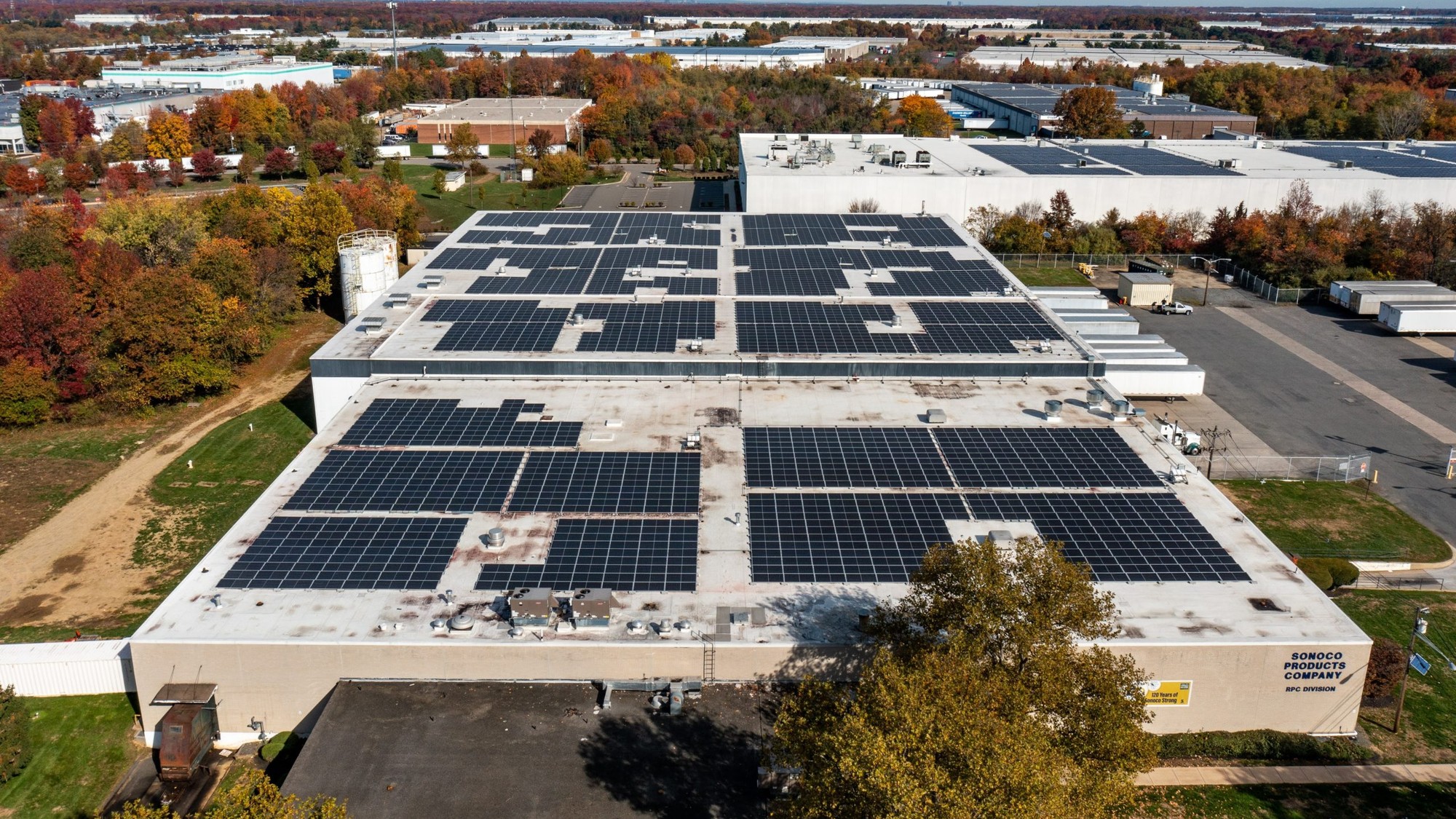
Commercial solar panels and battery storage have moved from “nice-to-have” sustainability projects to core business infrastructure. In 2026, the companies getting the strongest returns are not just buying solar panels to offset daytime electricity use; they are pairing them with battery energy storage systems to control demand charges, ride through outages, and create a more predictable energy budget. For businesses facing volatile utility rates, stricter ESG expectations, and growing pressure to keep critical operations online, solar plus storage is now a strategic asset.
Humless, a Battery Energy Storage company since 2010, has watched this market evolve from early pilot installations to a mature, financeable solution for commercial resilience. Today’s systems are smarter, safer, and more efficient than ever, with UL-certified components, advanced monitoring, and long-cycle-life lithium iron phosphate technology. Whether you are evaluating a compact solution like the Humless Universal 6kW BESS and 5kWh LiFePO4 Battery or designing a larger commercial array, the benefits in 2026 are tangible: lower operating costs, stronger continuity planning, and better control over how and when your business uses electricity.
Key Takeaways
- Commercial solar panels can reduce grid electricity purchases by 20% to 70% depending on roof space, load profile, and local sun conditions.
- Battery storage adds value beyond solar by reducing demand charges, shifting energy to higher-price periods, and keeping critical loads online during outages.
- Modern lithium iron phosphate systems typically offer 6,000+ cycles, 88% to 95% round-trip efficiency, and better thermal stability than older battery chemistries.
- Qualifying solar-plus-storage projects in 2026 may be eligible for the 30% federal ITC tax credit, improving project economics and shortening payback periods.
- UL certification, smart inverters, and properly designed energy management systems are essential for safety, insurance acceptance, and performance.
- For many businesses, the combination of solar panels and battery storage can reduce payback to roughly 4 to 8 years, depending on tariffs, incentives, and site conditions.
Why Commercial Solar and Battery Storage Matter More in 2026
Energy strategy in 2026 is less about simply buying kilowatt-hours and more about managing risk. Commercial electricity rates continue to fluctuate across regions, and many businesses are seeing the pain most clearly in demand charges, time-of-use pricing, and peak billing windows. Even if a company’s annual energy usage is steady, one or two high-demand intervals can materially increase the monthly bill. A battery changes that equation by allowing the business to smooth its load profile instead of paying premium rates for short spikes.
At the same time, weather-related outages, transformer failures, grid congestion, and localized utility interruptions remain a real operational risk. For a retail store, cold-storage facility, office campus, manufacturer, or healthcare-related site, downtime is not just an inconvenience. It can mean lost revenue, spoiled inventory, missed production schedules, data interruptions, or safety concerns. Solar plus storage gives businesses a way to produce power onsite and keep critical circuits running when the grid is unavailable.
In 2026, another important factor is customer and investor expectation. Commercial buildings are increasingly evaluated on operating efficiency, emissions profile, and resilience planning. Solar arrays help reduce Scope 2 emissions tied to electricity use, while storage improves the value of that solar by making it more usable when the sun is not available. A rooftop array without storage may export surplus daytime energy at a lower value than what the business pays later in the day. Battery storage helps capture more of that on-site generation and use it when electricity is most expensive.
There is also a technology maturity point. Commercial solar panels now commonly deliver module efficiencies in the 20% to 23% range, with premium modules reaching higher in some cases. Battery systems have improved too, particularly with lithium iron phosphate chemistry, which is known for long cycle life and strong thermal stability. The result is a more dependable, easier-to-manage asset that can be designed around a company’s actual operating profile rather than a generic one-size-fits-all model.
How Solar Panels and Battery Storage Lower Operating Costs
The most immediate benefit of commercial solar panels is straightforward: they reduce the amount of electricity a business has to buy from the grid. A well-designed 100 kW commercial rooftop solar system can generate roughly 130,000 to 170,000 kWh per year in many U.S. locations, depending on latitude, weather, shading, tilt, and orientation. If a business pays $0.12 to $0.20 per kWh, that generation can represent $15,600 to $34,000 in annual avoided utility purchases before incentives are even considered.
Battery storage creates a second layer of savings. In many commercial tariffs, a business may be charged not only for total energy consumed, but also for the highest short-duration power draw during the month. These demand charges can range from about $10 to $30 per kW-month in some markets and can be even higher under certain utility structures. If a battery can shave 40 kW from peak demand, that alone can save $400 to $1,200 per month depending on the tariff. For larger facilities, the savings can be far more substantial.
Storage also supports time-of-use arbitrage. If electricity costs $0.10 per kWh during the day but $0.24 per kWh during evening peaks, a battery can store solar energy or low-cost off-peak power and discharge it when the rate is highest. This is especially useful for businesses with late-afternoon or evening operating hours, refrigerated loads, or production schedules that extend into high-cost periods. The more the battery is controlled by a smart energy management system, the more value it can extract from these price differences.
Another financial benefit is reduced exposure to utility rate volatility. Many companies spend significant time planning budgets around energy costs, only to see rate increases erase projected margins. Onsite solar provides a more stable cost base, while storage helps optimize when power is imported or exported. Over the life of the system, this predictability can matter as much as the direct savings, especially for businesses with thin margins or contract-based pricing.
For some facilities, the strongest savings come from resilience plus cost control together. A battery can be sized to back up critical loads while also reducing monthly peak demand. That means the same asset is solving two business problems at once. Instead of paying solely for backup standby capacity or solely for solar generation, the business creates a hybrid system that is active every day and valuable during emergencies.
Technical Advantages of Modern Commercial Solar-Plus-Storage Systems
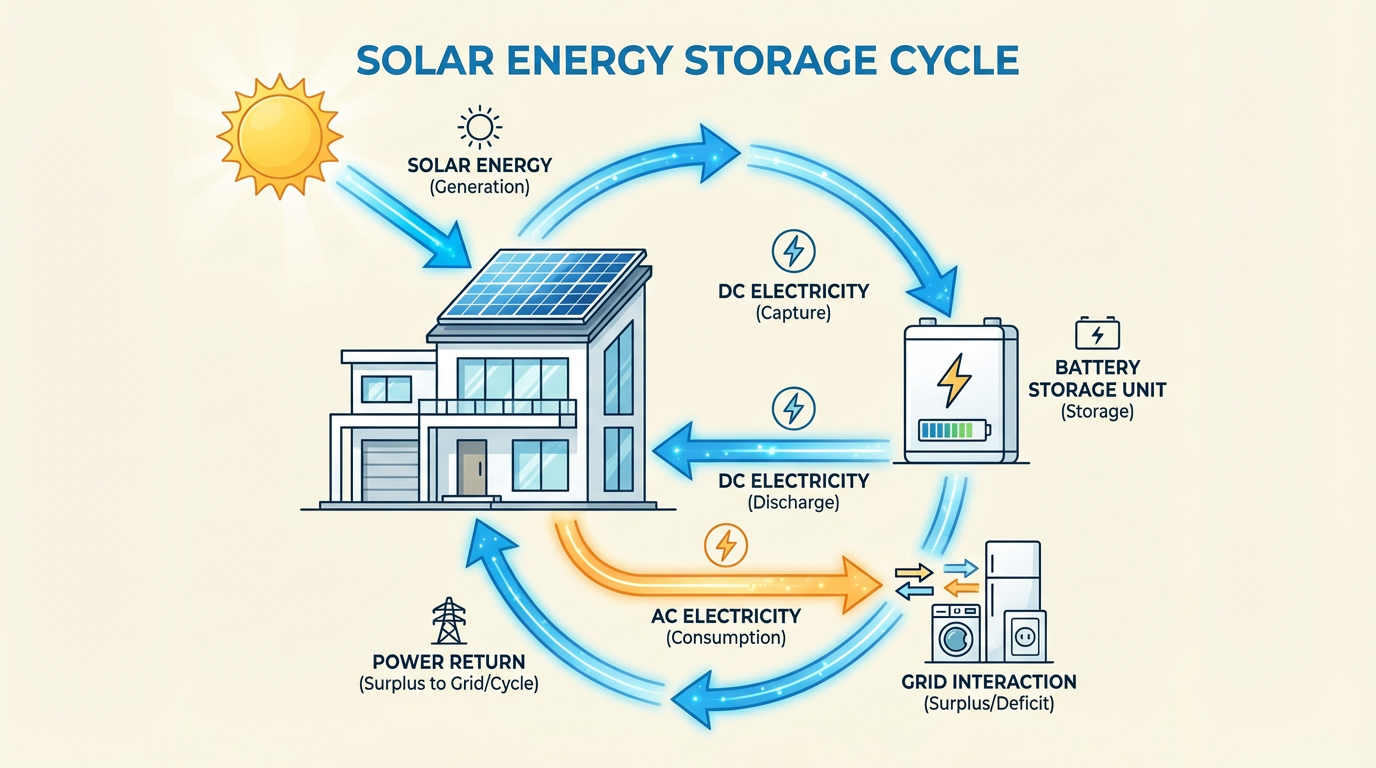
In 2026, the technical advantages of solar-plus-storage are not limited to basic backup power. Modern systems are designed to interact with the grid, facility loads, and onsite generation in real time. Smart inverters, advanced controls, and battery management systems work together to determine when to charge, discharge, or hold reserve energy. This is what turns a battery from a static box into an operational tool.
One of the biggest technical improvements is the widespread use of lithium iron phosphate, or LiFePO4, chemistry. Compared with older lithium-ion variants and legacy lead-acid batteries, LiFePO4 offers longer cycle life, strong thermal performance, and better suitability for daily cycling. Many commercial LiFePO4 systems are rated for 6,000 cycles or more at 80% depth of discharge, which is a major advantage for businesses that want to cycle the battery every day for demand management or energy shifting. Round-trip efficiency often lands in the 88% to 95% range, meaning most of the stored energy can be returned for use.
Thermal stability is another key advantage. Battery installations in commercial settings must handle higher usage intensity and often operate in more demanding ambient conditions than residential systems. LiFePO4 chemistry is valued because it is inherently more stable than some other lithium chemistries, which supports safer operation when systems are properly engineered and installed. This is one reason UL certification matters so much: it verifies that the system has been tested against recognized safety and performance standards, which helps with permitting, insurance, and authority having jurisdiction review.
Solar panel technology has also advanced. Higher module efficiencies mean businesses can fit more capacity into limited roof or carport space. That matters on warehouses, retail roofs, and urban properties where square footage is at a premium. A site that could previously support only a partial offset may now support a more meaningful slice of daytime load. When paired with battery storage, those higher-efficiency panels become even more valuable because surplus midday generation can be shifted into the late afternoon or evening.
Humless solutions reflect this shift toward practical, modular architecture. The Humless Universal 6kW BESS and 5kWh LiFePO4 Battery are examples of compact storage products that fit into a broader resilience strategy, especially for critical loads, small business continuity, telecom support, or facilities that need targeted backup power. For larger commercial applications, multiple units can be configured in parallel or integrated with a larger solar design to support greater power and energy needs. The key is that modern battery systems are scalable, controllable, and designed to be deployed with clear performance targets rather than guesswork.
Monitoring is also far more sophisticated than it used to be. A good commercial system should provide real-time visibility into solar production, battery state of charge, grid import/export, load demand, and outage status. Facility managers can use this data to confirm savings, identify abnormal patterns, and make smarter decisions about when to charge or discharge. In 2026, data is not optional; it is part of the value proposition.
Financial Incentives, Tax Strategy, and ROI in 2026
The economics of commercial solar and battery storage are stronger when incentives are properly applied. One of the most significant is the federal Investment Tax Credit, or ITC. For many qualifying projects placed in service in 2026, businesses may be eligible for the 30% federal ITC tax credit on qualified costs. This can substantially reduce the net cost of the project and improve internal rate of return. Because tax rules and eligibility can vary by project structure and tax situation, businesses should confirm details with a qualified tax advisor, but the credit remains one of the most powerful tools available.
In addition to the ITC, many businesses may be able to use accelerated depreciation methods, such as MACRS, where applicable. That matters because it can further improve the after-tax economics of the project by allowing a faster recovery of capital costs. When businesses combine federal incentives, possible state or local programs, utility rebates, and operating savings, the effective payback period can shrink significantly.
As a practical example, consider a facility installing a 250 kW solar system paired with a battery designed to shave peaks and support critical loads. If the solar array offsets 300,000 kWh annually and the facility’s blended utility cost is $0.14 per kWh, that alone may be worth about $42,000 per year. If battery dispatch saves an additional $8,000 to $20,000 annually through demand-charge reduction and time-of-use optimization, the total annual benefit can become very compelling. Apply a 30% ITC to eligible portions, and the net project economics improve further.
For many commercial sites, the realistic payback window lands somewhere in the 4 to 8 year range, although high-demand tariffs, strong incentive programs, and well-matched load profiles can push that lower. Sites with modest savings or limited usable roof space may take longer. The important point is that solar-plus-storage is no longer just an environmental statement; it is increasingly a capital project with measurable financial performance.
Businesses should also think in terms of avoided risk, not only direct utility savings. What is one outage worth to a retailer during peak season, a manufacturer with just-in-time shipments, or a clinic with sensitive scheduling? How much does a missed day of operations cost in labor, lost sales, or spoilage? Battery storage transforms those questions into an engineering and finance discussion. Even a small system can provide meaningful insurance against the kinds of disruptions that are difficult to budget for but easy to recognize after the fact.
Humless has seen this equation from multiple angles since 2010. As the market has matured, buyers have become more sophisticated about lifecycle value, warranty coverage, and system reliability. That is why product quality and installation integrity matter so much. A cheaper system that underperforms, degrades quickly, or creates permitting headaches can erase the savings it was supposed to produce. In contrast, a well-designed, UL-certified system with a strong warranty can protect the business case over the long term.
Where Businesses See the Biggest Benefits
Commercial solar panels and battery storage can help nearly any organization with a meaningful electric bill, but some business types see faster or larger returns than others. The best candidates are usually sites with high daytime loads, expensive demand charges, mission-critical operations, or limited tolerance for downtime.
Warehouses and distribution centers often have large rooftop surfaces and predictable daytime electricity use from lighting, conveyors, HVAC, and material handling. These facilities are excellent candidates for solar because roof area is typically abundant. Battery storage can help flatten peak demand from loading operations, refrigeration, or afternoon HVAC loads.
Retail locations benefit from solar because they are often open during daylight hours, which aligns well with generation. Batteries add value by supporting refrigeration, point-of-sale systems, lighting, and security during outages while also shaving peaks caused by customer traffic and cooling loads.
Manufacturing facilities often face the highest demand charges and the greatest cost from interruptions. A battery can help manage short spikes from motors, compressors, or production equipment, while solar offsets a meaningful portion of daytime energy use. Even partial backup coverage can prevent product loss or production delays.
Office campuses and professional buildings may have somewhat lower loads than industrial sites, but they still benefit from reduced utility bills, ESG reporting advantages, and stronger continuity for IT and communications systems. Solar carports can also add visible value for employees and visitors.
Farms, cold storage sites, and food-related operations often care deeply about both energy cost and power continuity. A short outage can damage inventory or disrupt temperature-sensitive operations. Battery storage can be configured to maintain critical loads until grid power returns or until a generator is started.
Healthcare-adjacent facilities, telecom sites, and critical infrastructure users tend to value resilience above all else. For these operations, the ability to maintain select loads during an outage can justify the project even before utility savings are counted. In these cases, a smaller modular system such as the Humless Universal 6kW BESS can be part of a layered power strategy, while larger facilities may deploy multiple units or combine storage with a larger commercial solar design.
System sizing should always start with a load study. A business that consumes 200 kWh per day has very different needs from one consuming 2,000 kWh per day. The right solution depends on the daily load shape, backup priorities, available roof or ground space, interconnection limits, and utility tariff structure. In many cases, the most successful projects are not the largest ones, but the ones sized to the real operating profile of the site.
How to Design, Install, and Maintain a Successful System with Humless
A successful commercial solar-plus-storage project starts with clear goals. Is the primary objective lower utility bills, backup power, demand-charge control, sustainability reporting, or all of the above? The answer determines array size, battery capacity, inverter configuration, and control logic. Businesses should begin with interval data from their utility bills whenever possible, because 15-minute load data reveals peak behavior far better than a monthly statement can.
From there, the engineering team can determine whether the site is best served by self-consumption, peak shaving, backup-only operation, or a combination. For example, a facility may want enough battery energy to cover a 2-hour outage for critical circuits, while also enabling daily discharge during the highest-cost billing window. That dual-purpose design is often more valuable than a battery dedicated to one use case alone.
Certification and compliance are critical. UL certification is not just a label; it is often a practical requirement for project approval, insurance acceptance, and safe operation. Commercial battery systems should be evaluated against relevant standards, and the installation should be carried out by experienced professionals familiar with local codes, interconnection requirements, and fire safety considerations. This is especially important in 2026 as jurisdictions become more attentive to energy storage permitting and inspection.
Humless brings years of field experience to this process. Founded in 2010, the company has been focused on battery energy storage long enough to understand what works in real-world deployments and what causes headaches later. Glenn Jakins, Humless Founder and CTO, brings 15+ years of experience and 15,000+ deployments to product and system design, which matters because commercial buyers need more than hardware; they need practical engineering guidance. That level of deployment experience helps identify the right battery configuration, the right inverter strategy, and the right operating assumptions before equipment is ordered.
Warranty and serviceability should also be part of the buying decision. A 10-year warranty is an important benchmark because it aligns better with commercial planning horizons and helps businesses model lifecycle cost with more confidence. Businesses should also ask about monitoring, support response times, parts availability, and whether the system is designed with expandability in mind. A good commercial solution should be able to grow with the business rather than becoming obsolete when energy needs change.
Maintenance requirements are usually manageable, especially for modern lithium-based systems, but they should not be ignored. Solar panels need periodic inspection and cleaning depending on site conditions. Batteries and inverters should be monitored for temperature, state of health, and performance anomalies. The best systems make this easy by surfacing actionable data instead of burying users in raw numbers. Over time, that reduces downtime and protects the return on investment.
Businesses should also plan for the future. In 2026, electricity use is increasingly shaped by electric vehicle charging, heat pumps, automation, and higher digital loads. Even if a current system looks sufficient today, a smart design should allow for expansion. Modular storage architectures are valuable because they let a company add capacity as load grows or as tariff changes make additional storage economically attractive.
Frequently Asked Questions
How much can a business save with commercial solar panels and battery storage?
Savings vary by location, tariff, roof space, and load profile, but many businesses can reduce grid electricity purchases by 20% to 70% with solar and gain additional savings from battery-based demand management. In some markets, batteries can cut demand charges by 20% to 50% or more when the system is properly sized and controlled.
Is battery storage worth it if we already have solar panels?
Yes, in many cases. Solar alone reduces daytime energy costs, but battery storage helps use that energy when electricity is most expensive, and it can provide backup power during outages. Storage also improves the value of solar by reducing exported surplus energy and supporting peak shaving.
What does UL certification mean for commercial battery systems?
UL certification means the system has been tested to recognized safety and performance standards, which is important for permitting, insurance, and code compliance. For commercial buyers, UL certification is a key sign that the equipment is suitable for professional installation and long-term operation.
Can a business qualify for the 30% federal ITC tax credit in 2026?
Many qualifying solar-plus-storage projects may be eligible for the 30% federal Investment Tax Credit, depending on how the project is structured and what the current tax rules require. Businesses should confirm eligibility with a qualified tax advisor, but the ITC remains one of the biggest incentives improving project economics.
If your business is evaluating commercial solar panels, battery storage, or a combined resilience strategy in 2026, Humless can help you build a system that fits your load, budget, and long-term goals. From compact options like the Humless Universal 6kW BESS and 5kWh LiFePO4 Battery to more advanced commercial storage planning, Humless offers the experience, UL-certified solutions, 10-year warranty support, and deployment knowledge businesses need to move forward with confidence. Contact Humless today for a consultation and discover how the right solar-plus-storage strategy can lower costs, strengthen resilience, and position your business for the future.