
More homeowners than ever are pairing solar panels with battery storage, and for good reason. A solar battery for your house doesn't just store sunshine: it gives you control over when and how you use the electricity your panels generate. Whether you're tired of losing power during storms, want to shrink your electric bill, or dream of cutting ties with the grid entirely, a home battery system can be the missing piece of your energy puzzle. But with dozens of models, confusing specs, and plenty of marketing hype, how do you choose the right one? This guide walks you through everything from how these systems work to the nitty-gritty of sizing, installation, and picking the technology that fits your home.
Key Takeaways
- A solar battery for your house stores excess daytime electricity to use at night, during cloudy days, or grid outages, giving you control over your energy consumption and backup power.
- Lithium-ion batteries, especially lithium iron phosphate (LiFePO₄), are the best choice for residential solar battery systems due to their 10–15 year lifespan, efficiency, and safety compared to lead-acid alternatives.
- Sizing your solar battery requires identifying critical loads, calculating daily consumption, and choosing between partial or whole-home backup coverage based on your energy priorities and budget.
- Home solar batteries typically cost $5,000–$10,000 installed and can reduce utility bills by allowing you to use stored midday solar energy during expensive peak evening hours.
- Proper installation in a temperature-controlled location with a critical-loads panel ensures safety, compliance with fire codes, and seamless integration with your existing or new solar panel system.
- Energy independence through a solar battery system provides resilience against grid outages, protection from rate hikes, and the flexibility to customize when and how you consume your generated solar power.
What Is a Solar Battery and How Does It Work?
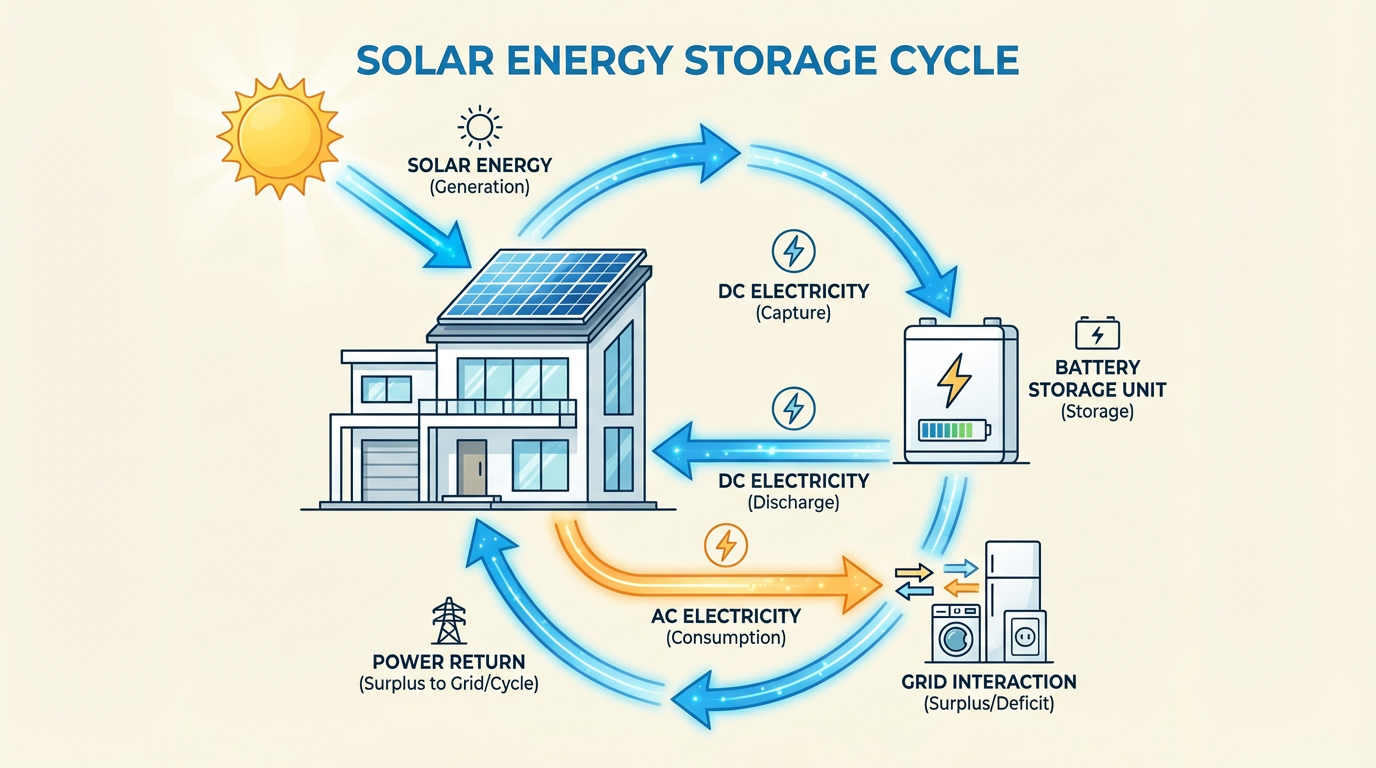
A solar battery is an energy storage device that captures excess electricity your solar panels produce during the day and saves it for later use, typically at night, on cloudy days, or during grid outages. Think of it as a rechargeable reservoir that sits between your solar array and your home's electrical panel.
Here's the basic flow: when your solar panels generate more power than your home is using, that surplus electricity charges the battery instead of being sent back to the utility grid. Later, when the sun sets or demand spikes, the battery discharges to power your lights, appliances, and HVAC. If the grid goes down, a properly configured battery can keep essential circuits running, sometimes for hours or even days, depending on capacity and load.
Most modern solar batteries use an inverter to convert DC electricity (what the battery stores) into AC power (what your home uses). Some systems feature an integrated hybrid inverter that manages both solar input and battery charging in one unit, while others use separate inverters. Advanced models also include smart software that monitors grid status, optimizes charge/discharge cycles, and even participates in utility demand-response programs to save you money.
Key Benefits of Installing a Solar Battery for Your Home
Adding a battery to your solar setup unlocks several advantages you just can't get from panels alone. The most obvious is backup power. When a storm knocks out the grid, your battery-backed solar system can keep the fridge cold, the Wi-Fi running, and the medical devices charged, no noisy, fuel-guzzling generator required.
Beyond emergencies, batteries deliver better solar self-consumption. Without storage, any electricity your panels produce beyond real-time demand flows back to the grid, often at a lower credit rate than what you pay to buy power back at night. A battery lets you bank that midday surplus and use it during expensive evening peak hours, directly cutting your utility bill.
Batteries also pave the way for energy independence. For homeowners in areas with unreliable grids, high electricity rates, or no utility service at all, a properly sized solar-plus-storage system can dramatically reduce, or eliminate, reliance on the power company. Businesses and off-grid property owners find this especially valuable, as it offers predictable costs and resilience against rate hikes or prolonged outages.
Energy Independence and Backup Power
Energy independence means more than just keeping the lights on: it's about taking control. With a solar battery, you decide how and when to use the energy you generate. In a full off-grid setup, your battery (often paired with a generator for redundancy) becomes your primary power source. Even if you stay grid-tied, a battery gives you the freedom to ride out outages, avoid time-of-use penalties, and reduce your carbon footprint, all while insulating yourself from utility politics and infrastructure failures.
Humless BESS has been helping homeowners and businesses achieve exactly this since 2010, offering UL-certified battery energy storage systems that integrate seamlessly with solar, wind, and backup generators. Their 24/7 support and proven track record make the transition to energy independence smoother and more reliable.
Types of Solar Batteries: Finding the Right Technology
Not all solar batteries are created equal. The two main chemistries you'll encounter are lithium-ion and lead-acid, each with distinct trade-offs.
Lithium-ion batteries dominate the residential market in 2026. They're compact, efficient, and boast a longer lifespan, often 10–15 years or 5,000+ cycles. Within this category, lithium iron phosphate (LiFePO₄) stands out for safety and thermal stability, making it a favorite for home installations. LiFePO₄ batteries don't suffer from thermal runaway as easily as other lithium chemistries, and they handle deep discharges well, which is critical for backup scenarios.
Lead-acid batteries are the older technology. They're cheaper upfront but heavier, bulkier, and have shorter lifespans (3–7 years). They also require regular maintenance if you choose flooded models, and they don't tolerate deep discharges as gracefully. For most homeowners, lead-acid is only worth considering if budget constraints are severe or if you're adding to an existing off-grid system already built around them.
There's also emerging tech like saltwater and flow batteries, but these remain niche and less widely available for typical residential use. Stick with lithium-ion, preferably LiFePO₄, for the best balance of performance, safety, and longevity.
How to Choose the Right Solar Battery for Your House
Choosing a solar battery starts with asking yourself one question: what do I need this battery to do? Are you looking for whole-home backup during multi-day outages, or just enough juice to keep the essentials running for a few hours? Your answer will shape every other decision.
Next, consider lifespan and warranty. A battery that lasts 15 years with a solid warranty is worth more than a cheap unit that dies in five. Look for throughput guarantees (total energy the battery can deliver over its life) and cycle ratings, not just calendar years.
Cost matters, of course. Installed prices for home solar batteries typically range from $5,000 to $10,000 per unit, and larger or more complex systems can run higher. But don't just chase the lowest sticker price, factor in efficiency, round-trip losses, and compatibility with your existing (or planned) solar array.
Finally, think about scalability. Some systems let you start with one battery and add more later as your energy needs grow or your budget allows. Modular, expandable platforms give you flexibility without locking you into a single capacity forever.
Capacity, Power Output, and Sizing Considerations
Capacity tells you how much energy a battery can store, measured in kilowatt-hours (kWh). A typical home backup battery holds around 10–13.5 kWh, enough to run essential loads like refrigeration, lighting, and internet for several hours or longer if you're conservative with usage.
Power output (measured in kilowatts, or kW) determines how much electricity the battery can deliver at once. A battery might store 13 kWh but only output 5 kW continuously, meaning you can't run every appliance simultaneously. If you want to back up heavy loads like air conditioning or an electric stove, you'll need higher continuous and peak power ratings.
Sizing depends on your daily consumption, backup priorities, and whether you want partial or whole-home coverage. Start by identifying critical circuits: fridge, lights, medical devices, Wi-Fi. Add up their wattage and estimate runtime. Many installers recommend 1.5–2× your calculated need to account for inefficiencies and future load growth. For off-grid setups, you'll want several days of autonomy, which often means stacking multiple batteries.
Installation and Integration with Your Solar System
Installing a solar battery can happen in two scenarios: alongside new solar panels or as a retrofit to an existing system. New installs are simpler, your installer designs everything together, so the inverter, wiring, and panels are all spec'd to work seamlessly. Retrofits require more planning: you may need a new hybrid inverter or an AC-coupled battery solution, plus additional permitting and electrical work.
Most battery systems require a critical-loads panel or a gateway device that isolates backed-up circuits from the rest of your home. This ensures the battery doesn't waste energy trying to power your entire house during an outage and prevents backfeeding into the grid, which is both dangerous and often illegal.
Location is crucial. Batteries should be installed in a temperature-controlled space, ideally a garage, utility room, or climate-controlled outdoor enclosure. Extreme heat or cold can degrade performance and shorten lifespan. Fire safety codes often dictate clearances, ventilation, and proximity to living spaces, especially for lithium-ion units.
Integration with solar is usually straightforward if you choose compatible equipment. DC-coupled systems are more efficient (fewer conversion losses), while AC-coupled setups offer more flexibility and easier retrofits. Either way, working with an experienced installer who understands local codes, utility interconnection rules, and battery commissioning is essential.
Companies like Humless offer turnkey battery energy storage systems designed to integrate smoothly with solar, grid, wind, and generator inputs, backed by 15+ years of expertise and around-the-clock support to ensure your installation goes off without a hitch and performs reliably for years to come.
Frequently Asked Questions About Solar Batteries for Homes
What is a solar battery for house and how does it work?
A solar battery stores excess electricity generated by your solar panels during the day for later use at night or during outages. It captures surplus power that would otherwise go to the grid, converts it through an inverter, and discharges to power your home when solar production is low or the grid is down.
How much does a solar battery for house installation typically cost?
Installed solar battery costs typically range from $5,000 to $10,000 per unit, depending on capacity, technology, and system complexity. Larger systems or multiple batteries can cost more, but consider warranty, efficiency, and long-term value rather than upfront price alone.
What are the main benefits of installing a home solar battery?
Solar batteries provide backup power during outages, enable energy independence by reducing reliance on the grid, and improve solar self-consumption by letting you use more of your own generated electricity during peak-rate evening hours instead of buying it back.
How do I determine the right battery capacity for my home?
Battery capacity depends on your daily consumption and backup priorities. A typical home backup battery is around 13.5 kWh for essential loads like refrigeration and lighting. Calculate your critical circuits' wattage, estimate runtime, and size 1.5–2× that for inefficiencies and future growth.
What's the difference between lithium-ion and lead-acid solar batteries?
Lithium-ion batteries are more efficient, compact, and last 10–15 years or 5,000+ cycles, making them ideal for homes. Lead-acid is cheaper but heavier, requires maintenance, lasts only 3–7 years, and doesn't handle deep discharges well. Lithium-ion, especially LiFePO₄, is the modern choice for residential use.
Can I add a solar battery to my existing solar panel system?
Yes, you can retrofit a battery to an existing solar installation, though it requires more planning than a new system. You may need a new hybrid inverter, additional permitting, and electrical work. AC-coupled solutions offer flexibility for retrofits, but work with an experienced installer familiar with local codes.