
You've invested in solar panels to reduce your utility bills and shrink your carbon footprint. But what happens when the sun sets or the grid goes down? Without battery storage, all that clean energy you generate during the day goes straight back to the utility, and you're left in the dark during outages. Solar array battery storage changes that equation entirely. By capturing excess solar production and storing it for later, you gain control over your energy, slash dependence on the grid, and keep the lights on when everyone else loses power. In this guide, you'll discover how solar battery storage works, the benefits it delivers to homeowners and businesses, and how to choose the right system for your needs.
Key Takeaways
- Solar array battery storage captures excess daytime solar energy and stores it for use during evenings, nights, and grid outages, providing energy independence and backup power when the grid fails.
- Energy time-shifting through battery storage allows you to use stored solar power during peak-demand evening hours instead of buying expensive grid electricity, especially on time-of-use rate plans where savings compound monthly.
- LiFePO4 lithium batteries are the gold standard for solar installations, offering 3,000–6,000+ charge cycles, 80–100% usable capacity, superior safety, and minimal maintenance compared to older lead-acid alternatives.
- Proper battery sizing requires calculating your daily energy consumption, nighttime load coverage, backup duration, and solar production surplus—typical residential systems range from 5–40+ kWh depending on your energy goals and home size.
- Modern battery energy storage systems integrate seamlessly with solar panels, generators, and the grid through intelligent controllers and inverters, delivering hands-off operation and 10–15 year lifespans with UL certification and proven reliability.
- Working with an experienced installer to design a modular, scalable solar battery storage system lets you start with minimal backup and expand capacity as your needs grow, maximizing your long-term energy resilience and ROI.
What Is Solar Array Battery Storage and How Does It Work?
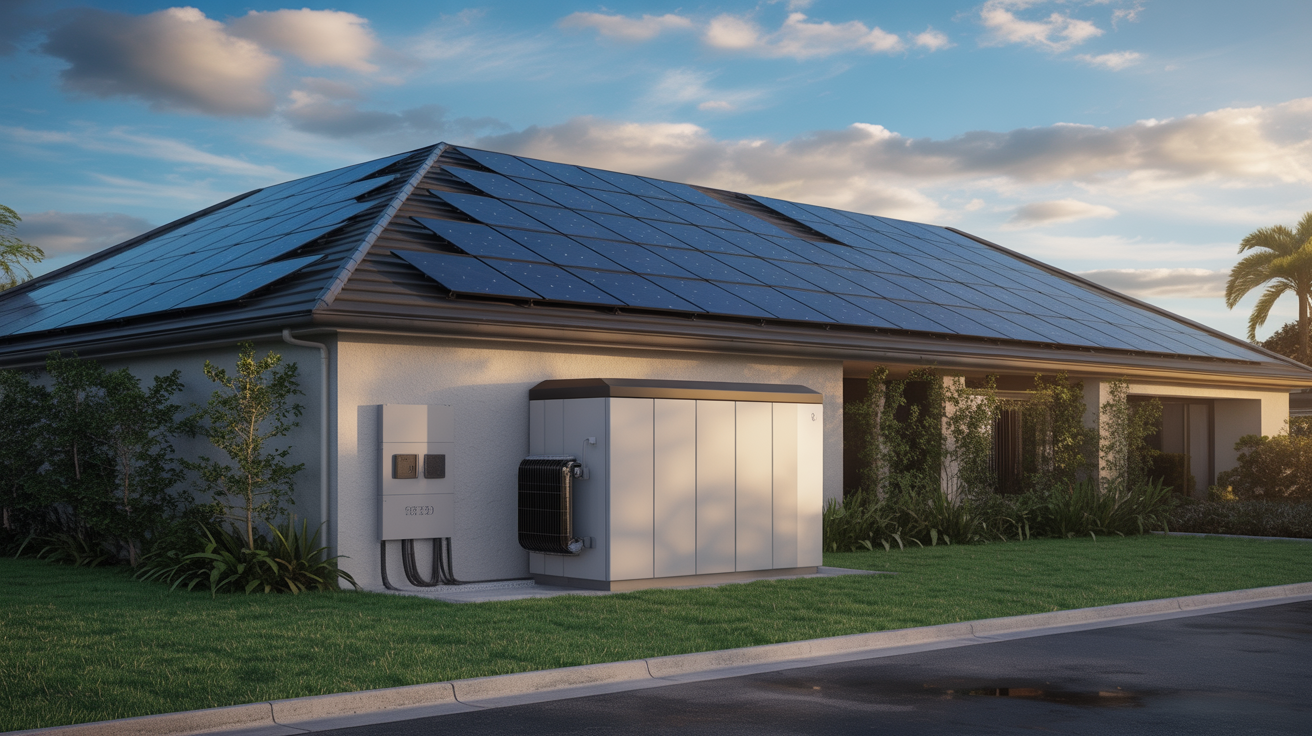
Solar array battery storage is a system that captures and stores the electricity your solar panels produce, making it available whenever you need it, day or night. Here's the straightforward process:
Your solar panels generate direct current (DC) electricity when sunlight hits them. An inverter then converts that DC power into alternating current (AC) electricity, which is what your home or business uses. When your solar production exceeds your immediate demand, say, on a sunny afternoon when you're at work, the excess energy flows into your battery storage system instead of exporting back to the utility grid.
Once stored, that energy sits ready until you need it. When the sun goes down and your panels stop producing, or during a grid outage, your battery automatically discharges to power your home. Modern battery energy storage systems (BESS) use intelligent charge controllers and inverters to manage the flow seamlessly, prioritizing solar first, then battery reserves, and finally grid power if needed.
The typical energy flow looks like this:
- Daytime (high solar production): Solar powers your home, charges your battery, and any surplus may export to the grid.
- Evening/night (no solar production): Battery storage powers your home, reducing or eliminating grid purchases.
- Outage: Battery provides backup power to keep critical, or all, loads running.
Many battery energy storage systems integrate with solar, grid, wind, and generator sources, giving you flexible, layered power management. That versatility is key for off-grid properties, grid-tied homes seeking backup, and commercial sites aiming for energy cost control.
Key Benefits of Adding Battery Storage to Your Solar Array
Energy Independence and Grid Outage Protection
The primary appeal of battery storage is simple: you stop relying on the utility for every kilowatt-hour. When your solar array is paired with batteries, you keep more of the electricity you generate and use it when it matters most. That means fewer trips to the grid, lower bills, and real resilience when the grid goes down.
During a blackout, grid-tied solar systems without batteries shut down automatically for safety, even in bright sunshine. Add battery storage, and your system can island from the grid, keeping essential appliances running: refrigerators, medical devices, Wi-Fi, lighting, and heating or cooling systems. Some homeowners size their battery for critical loads only (a few hours of essentials), while others invest in whole-home backup that can last days.
For off-grid properties and remote businesses, battery storage isn't optional, it's the backbone of reliable power. And even for suburban homes, the peace of mind during storm season or rolling blackouts is worth its weight in gold.
Maximizing Solar Investment Through Energy Time-Shifting
Solar panels produce the most electricity during midday, but most households and businesses use the most power in the evening, after the sun has set. Without storage, you're forced to buy expensive grid electricity during those peak hours, even though your panels were cranking out free energy just hours earlier.
Battery storage solves this mismatch through energy time-shifting: you store your midday solar surplus and discharge it during evening peak demand. The result? You use more of your own clean energy and buy less from the utility, especially during high-cost peak periods.
If you're on a time-of-use (TOU) rate plan, the savings multiply. You can charge your battery from solar (or even from the grid during cheap off-peak hours), then discharge during expensive on-peak windows. This strategy, sometimes called arbitrage, turns your battery into a money-saving workhorse that pays dividends month after month.
Plus, battery storage requires relatively low maintenance compared to generators or older lead-acid systems. Modern lithium systems are set-and-forget, monitored remotely, and built to last 10–15 years or more with thousands of charge cycles.
Choosing the Right Battery Storage System for Your Solar Array
LiFePO4 vs. Other Battery Chemistries: What Homeowners and Businesses Need to Know
Not all battery chemistries are created equal. The two most common types you'll encounter are lithium iron phosphate (LiFePO4) and older lead-acid batteries, with a few systems using other lithium chemistries like NMC (nickel manganese cobalt).
LiFePO4 batteries have become the gold standard for solar storage, and for good reason:
- Long cycle life: LiFePO4 cells routinely deliver 3,000 to 6,000+ cycles, meaning they can charge and discharge daily for a decade or longer.
- High usable depth of discharge (DoD): You can safely use 80–100% of the rated capacity without damaging the battery, unlike lead-acid which degrades quickly if you discharge below 50%.
- Superior safety: LiFePO4 is thermally stable and far less prone to thermal runaway or fire compared to other lithium chemistries.
- Lower maintenance: No water topping, no equalization cycles, just reliable, hands-off operation.
Lead-acid batteries (flooded or sealed AGM/gel) are older technology. They cost less upfront but come with trade-offs: shorter lifespan (typically 500–1,000 cycles), lower usable capacity, regular maintenance, and greater sensitivity to temperature and discharge depth. For most modern solar installations, lead-acid is a false economy.
When evaluating systems, look for UL-certified batteries and proven track records. Humless BESS systems use UL-certified LiFePO4 technology and have been field-tested for over 15 years, offering the reliability and safety homeowners and businesses demand.
Sizing Your Battery Storage Capacity for Your Energy Needs
Choosing the right battery size is critical. Too small, and you'll run out of power before sunrise or during an outage. Too large, and you're paying for capacity you'll never use.
Start by understanding your daily energy consumption. The average U.S. home uses about 30 kWh per day, though efficient homes may use closer to 20 kWh, and larger homes with electric heating or cooling can exceed 40 kWh. Check your utility bills or smart meter data for your actual usage.
Next, consider your goals:
- Evening load coverage: If you want to power your home from sunset to sunrise (roughly 12 hours), estimate your nighttime consumption. For many households, that's 8–12 kWh. A single 10 kWh battery may suffice.
- Backup power: Determine which loads are essential during an outage (refrigerator, lights, medical devices, internet) and how long you want them to run. Critical-load backup might need just 5–10 kWh, while whole-home backup for 24–48 hours could require 20–40+ kWh.
- Solar production: Your battery should store enough to capture your typical midday surplus. If your array produces 15 kWh more than you use during the day, a 15 kWh battery lets you capture it all.
Typical residential battery sizes:
- 5–7 kWh: Minimal backup or partial load shifting.
- 10–15 kWh: Common for average homes seeking evening coverage and moderate backup.
- 20–40+ kWh: Whole-home backup, larger homes, or off-grid applications.
Don't forget power output (measured in kW). A battery might hold 10 kWh, but if it can only discharge at 3 kW, you can't run heavy loads like an air conditioner or electric stove simultaneously. Match both capacity (kWh) and power (kW) to your needs.
Finally, work with an experienced installer or integrator who can model your usage, solar production, and backup requirements. Systems like Humless BESS are modular and scalable, so you can start smaller and expand capacity as your needs grow, future-proofing your energy independence.
Frequently Asked Questions About Solar Array Battery Storage
What is solar array battery storage and how does it work?
Solar array battery storage captures excess electricity generated by your solar panels and stores it for later use. When sunlight hits your panels, they generate DC electricity, which an inverter converts to AC power for your home. Excess energy charges the battery instead of exporting to the grid, and you can discharge it at night, during peak demand, or outages.
How much does solar array battery storage cost, and what is the payback period?
Battery storage system costs vary widely, typically ranging from $5,000 to $15,000+ depending on capacity and chemistry. Payback periods depend on your utility rates, solar production, and available incentives—usually 5–10 years. Time-of-use rate plans and backup protection can accelerate ROI significantly.
What are the main benefits of adding battery storage to solar panels?
Battery storage increases energy independence by letting you use more of your generated solar power, reduces grid electricity purchases, provides backup power during outages, and enables energy time-shifting to avoid expensive peak-rate hours. It also requires minimal maintenance compared to older systems.
Should I choose LiFePO4 or lead-acid batteries for my solar system?
LiFePO4 is the modern standard for solar storage, offering 3,000–6,000+ charge cycles, 80–100% usable depth of discharge, superior safety, and low maintenance. Lead-acid batteries are cheaper upfront but degrade faster (500–1,000 cycles), require regular maintenance, and deliver lower usable capacity.
How much battery capacity do I need for my home?
Battery sizing depends on your daily consumption, backup goals, and solar production. Average homes use 8–10 kWh nightly; a 10–15 kWh battery covers evening load-shifting. Critical-load backup needs 5–10 kWh; whole-home backup for 24–48 hours requires 20–40+ kWh. Work with an installer to size correctly.
Can solar battery storage keep my home powered during a grid outage?
Yes. Grid-tied solar without batteries shuts down during outages for safety, but adding battery storage lets your system island from the grid and power essential loads—refrigerators, lighting, medical devices, Wi-Fi, and heating/cooling. Whole-home systems can provide backup for days, depending on capacity and usage.