Finding the best battery bank for RV travel can transform your off-grid experience from stressful battery babysitting into true energy independence. Whether you're weekend camping or full-timing across the country, the right battery bank keeps your lights on, fridge cold, and devices charged, without constant trips to shore power. Today's top RV battery banks are built around LiFePO4 (lithium iron phosphate) technology, delivering 8–15 years of reliable service, ultra-light weight, and near-total usable capacity. In this guide, we'll walk you through seven proven battery-bank approaches, from gold-standard LiFePO4 house banks to portable power stations and UL-certified integrated systems, so you can choose the setup that fits your power needs, solar plans, and budget.
Key Takeaways
- LiFePO4 battery banks deliver 8–15 years of reliable service with 3,000–5,000+ cycles, making them the gold standard for RV energy independence compared to lead-acid alternatives that last only 2–3 years.
- A quality RV battery bank using LiFePO4 technology maintains stable voltage throughout discharge and provides 95–100% usable capacity, so your lights stay bright and appliances run smoothly until the battery is nearly empty.
- Portable power stations offer plug-and-play convenience for supplemental power on small RVs and weekend trips, but can't fully replace a dedicated house bank for extended boondocking beyond their typical 1,000–3,000 Wh capacity.
- Modular LiFePO4 banks let you scale incrementally from a single 100Ah battery to 400+ Ah over multiple seasons, matching your growing energy appetite without replacing your original system.
- High-capacity integrated systems combining 3–4 × 100Ah LiFePO4 batteries with 400–800 W solar deliver true off-grid independence for full-time RVers, enabling you to run appliances for days without shore power or a generator.
- When selecting a battery bank for your RV, prioritize UL 1973 / UL 9540A certified LiFePO4 systems with an RV-grade BMS to ensure safety, performance, and protection of both your rig and insurance coverage.
1. LiFePO4 Battery Banks: The Gold Standard for RV Energy Storage
If you're serious about RV independence, LiFePO4 battery banks are the benchmark. Brands like Battle Born, SOK, Epoch, Renogy Smart, LiTime, Power Queen, and Dakota dominate the market for good reason: they outlast, outperform, and outweigh traditional lead-acid in every metric that matters.
A typical 100Ah LiFePO4 cell weighs around 25–30 pounds versus 60–70 pounds for an equivalent AGM, that's 50–70% lighter for the same capacity. You can mount four 100Ah LiFePO4 batteries on an RV roof rack or in an exterior bay without worrying about frame stress or suspension sag. And because lithium delivers 95–100% usable capacity, a 300Ah LiFePO4 bank gives you roughly the same real-world energy as a 600Ah AGM setup, at half the weight and a fraction of the footprint.
LiFePO4 batteries also maintain a flat voltage curve (typically 13.2–13.6 V) throughout the discharge, so your RV electronics, fridge, LED lights, water pump, run at stable voltage until the battery is nearly empty. No more dimming lights or sluggish appliances when your state of charge drops below 50%.
Why LiFePO4 Outperforms Traditional Lead-Acid
Cycle life is where lithium truly shines. A quality LiFePO4 bank delivers 3,000–5,000+ cycles at 80% depth of discharge, translating to 8–15 years of daily use. In contrast, AGM and flooded lead-acid batteries offer only 300–500 cycles at 50% DOD, meaning you'll replace them every 2–3 years under the same workload.
LiFePO4 is also inherently safer than other lithium chemistries. Unlike NMC (nickel-manganese-cobalt) or generic lithium-ion cells, LiFePO4 resists thermal runaway under normal conditions and doesn't off-gas hydrogen during charging. The integrated battery management system (BMS) in modern RV LiFePO4 packs monitors cell voltage, temperature, and current in real time, cutting off charge or discharge before dangerous conditions develop.
Finally, lithium's high charge efficiency (95–98%) means your solar panels and shore charger pump nearly every watt into usable storage, instead of wasting 20–30% as heat like lead-acid does. On a cloudy day or short drive, that efficiency gap can mean the difference between a topped-off bank and running your generator.
2. Portable Power Stations: Versatile Backup for RV Living
Portable power stations, compact lithium battery packs with built-in inverter, charge controller, and multiple AC/DC/USB outputs, offer plug-and-play convenience for RVers who don't want to rewire their rig or who need supplemental power outside the main house bank.
Think of a portable station as a battery, inverter, and charger in one suitcase. You can charge it from your RV's 12 V system, shore power, solar panels, or even your truck's alternator, then carry it to a campsite picnic table to run a laptop, CPAP machine, or electric grill without draining your main RV battery.
Portable stations shine in small RVs, camper vans, and weekend trips where installing a permanent house bank is overkill. They're also fantastic outdoor workstations: power your drill, circular saw, or blender at a tailgate without firing up a noisy generator.
When shopping, prioritize LiFePO4-based stations with UL-listed internal batteries and proven BMS protections. Generic lithium-ion models may offer higher energy density, but LiFePO4 delivers better thermal stability and longer cycle life, critical when your power station sits in a hot RV storage bay all summer.
That said, portable stations aren't a full replacement for a dedicated house bank if you're boondocking for weeks at a time. Their capacities typically max out around 1,000–3,000 Wh, and inverter ratings rarely exceed 2,000 W continuous, fine for lights and laptops, but not enough to run a roof AC or induction cooktop for long. Use them as tactical supplements to your main bank, freeing up house-battery capacity for critical loads.
3. High-Capacity Integrated Systems: Complete Energy Independence on the Road
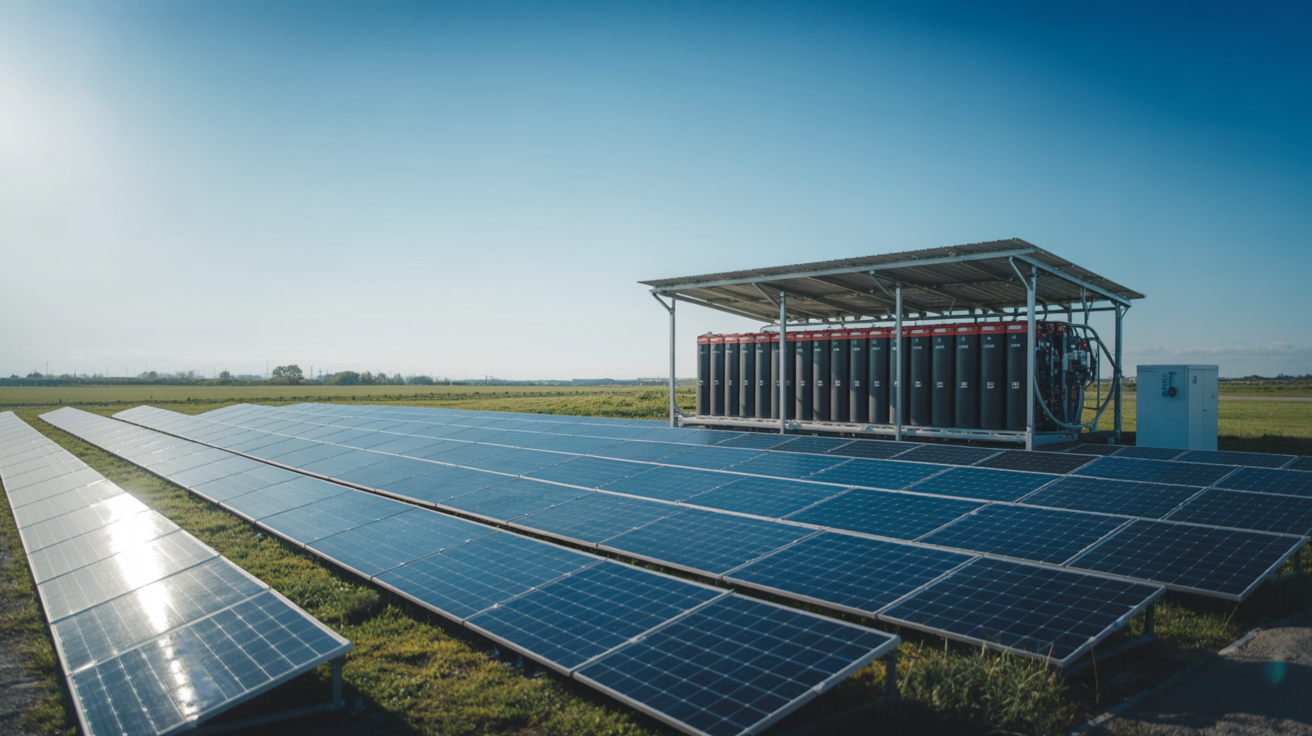
Full-time boondockers and off-grid enthusiasts often build high-capacity integrated systems, typically 3–4 × 100Ah LiFePO4 batteries (4,000–5,000 Wh total) paired with 400–800 W of rooftop solar and a robust inverter/charger. This setup delivers true energy independence: run your fridge, water heater, microwave, and entertainment system for days without plugging in or cranking the generator.
Integrated systems combine the house battery bank, solar charge controller, inverter, and monitoring into a single coordinated architecture. Advanced setups use CAN-bus communication between components, your Victron SmartSolar MPPT talks to your Battle Born batteries, which talk to your MultiPlus inverter, so you get real-time state-of-charge, solar yield, and load data on one screen.
The result? You know exactly how much energy you're harvesting, storing, and consuming, and you can tweak your usage before you hit reserve levels. No more guessing whether you can run the air conditioner or if you'll wake up to a dead battery.
Solar Integration Capabilities
When designing a high-capacity system, solar integration is non-negotiable. Look for LiFePO4 batteries that explicitly support high charge currents (0.5 C to 1 C) and can handle the multi-stage charging profiles of modern MPPT controllers like the Victron SmartSolar or Renogy DCC50S.
LiFePO4's 95–98% charge efficiency means your 400 W solar array delivers nearly 400 W into the battery (minus controller losses), versus only 280–320 W with AGM. Over a sunny afternoon, that extra 20–25% translates to an additional 200–400 Wh, enough to skip an evening generator run.
Ensure your charge controller has a LiFePO4 preset or customizable profile: bulk at 14.4–14.6 V, brief absorption, and float at 13.6 V (or disabled). Many LiFePO4 batteries include a low-temperature charge cutoff in the BMS, automatically blocking charge below 32°F to prevent lithium plating, critical if you camp in cold climates.
4. Modular Battery Banks: Scalable Power for Growing Needs
One of LiFePO4's biggest advantages for RVers is modularity: start with one or two 100Ah batteries and expand as your energy appetite grows. Nearly every major RV lithium brand, SOK, Epoch, Battle Born, LiTime, Power Queen, designs their batteries to be paralleled (for more amp-hours) or series-connected (for 24 V or 48 V systems) without complex balancing circuits.
A modular approach lets you scale incrementally. Install a single 100Ah battery and 200 W solar panel for your first season, see how it performs, then add a second 100Ah battery and another panel the following year. By season three you might have 400–600Ah and enough solar to stay off-grid indefinitely, all without ripping out and replacing your original gear.
Modular banks also enable dedicated sub-systems: one 200Ah bank exclusively for your inverter (microwave, coffee maker, power tools), and a separate 100Ah bank for 12 V house loads (lights, water pump, fans). This segmentation prevents high-draw AC loads from starving critical DC circuits, and it simplifies troubleshooting when something goes wrong.
When building a modular bank, match battery models and firmware versions within each parallel string. Mixing brands or vintages can lead to imbalanced charge/discharge rates and premature cell degradation. Most manufacturers publish detailed parallel/series wiring diagrams and max-string guidelines, follow them closely.
Finally, ensure your inverter and charge controller can handle the total current of your expanded bank. A 400Ah LiFePO4 bank can theoretically accept 200–400 A charge current (0.5–1 C rate), so a 30 A shore charger will be painfully slow. Budget for a 60–100 A converter/charger or a high-output alternator charging solution if you plan to scale beyond 300Ah.
5. UL Certified Battery Systems: Safety Meets Performance
As lithium batteries flood the RV market, safety certifications have become the dividing line between reputable systems and risky knockoffs. UL 1973 (Standard for Batteries for Use in Stationary, Vehicle Auxiliary Power, and Light Electric Rail Applications) and UL 9540A (Test Method for Evaluating Thermal Runaway Fire Propagation) are the gold standards.
UL 1973 validates that a battery system's electrical, mechanical, and thermal design meets strict safety benchmarks: proper BMS operation, short-circuit protection, vibration and shock resistance, and safe failure modes. UL 9540A goes further, testing whether a single-cell thermal event will cascade through the entire pack, critical in an enclosed RV environment.
Many RVIA (RV Industry Association) manufacturers now require UL-listed batteries for new builds, and insurers are starting to ask for certification documentation before covering lithium-equipped rigs. If you're installing aftermarket, choosing a UL 1973 / UL 9540A system protects both your safety and your insurance policy.
Beyond the UL mark, look for batteries with an RV-grade BMS that includes:
- Low-temperature charge cutoff (prevents charging below freezing)
- High-temperature discharge cutoff (shuts down if cells overheat)
- Realistic continuous/peak current ratings (not inflated marketing specs)
- Cell-level voltage balancing (keeps all cells within ±50 mV)
Humless, a pioneer in battery energy storage systems since 2010, offers UL-certified LiFePO4 solutions engineered for RV, off-grid, and backup-power applications, with 24/7 support and proven field reliability across thousands of installations.
When you're choosing your RV battery bank, prioritize LiFePO4 chemistry, documented UL 1973 / UL 9540A testing, and an integrated RV-grade BMS. These three pillars, performance, safety, and intelligent management, ensure your battery bank delivers years of confident, trouble-free power on the road.
Frequently Asked Questions About the Best Battery Banks for RVs
What is the best battery bank for RV travel?
LiFePO4 battery banks are the gold standard for RVs today. They deliver 3,000–5,000+ cycles (8–15 years), 95–100% usable capacity, and weigh 50–70% less than equivalent AGM batteries. Top brands include Battle Born, SOK, Epoch, Renogy Smart, LiTime, and Power Queen.
How long do LiFePO4 RV batteries last compared to lead-acid?
LiFePO4 batteries last 8–15 years with 3,000–5,000+ cycles at 80% depth of discharge, versus only 2–3 years for AGM or lead-acid (300–500 cycles). Over a lifetime, LiFePO4 systems cost significantly less despite higher upfront prices.
Can I use a portable power station as my main RV battery bank?
Portable power stations work best as supplements, not primary house banks. Their capacities max out around 1,000–3,000 Wh and inverter ratings rarely exceed 2,000 W continuous—fine for laptops and lights, but insufficient for sustained loads like roof AC or induction cooktops.
What solar power rating pairs best with a LiFePO4 RV battery bank?
A high-capacity integrated system typically pairs 3–4 × 100Ah LiFePO4 batteries (4,000–5,000 Wh) with 400–800 W of rooftop solar. LiFePO4's 95–98% charge efficiency maximizes solar harvest, delivering 20–25% more usable energy into your battery than AGM setups.
Should I buy UL-certified RV battery banks?
Yes. UL 1973 and UL 9540A certifications validate safety, thermal stability, and BMS reliability. Many RVIA manufacturers require UL-listed batteries for new builds, and insurers increasingly request certification documentation before covering lithium-equipped RVs.
Can I start with one LiFePO4 battery and expand later?
Absolutely. Most major RV lithium brands (SOK, Epoch, Battle Born, LiTime, Power Queen) design modular systems that parallel or series-connect without complex balancing. Start with 100Ah and scale to 400–600Ah as your energy needs grow over multiple seasons.