

Energy independence isn't just a dream anymore, it's a practical reality for thousands of homeowners and businesses who've discovered battery storage. If you've ever sat in the dark during a power outage, watched your electric bill climb month after month, or wondered what to do with all that excess solar power your panels generate at noon, you're not alone. Battery Energy Storage Systems (BESS) have evolved from niche technology to mainstream solutions that put control back in your hands.
Since 2010, pioneers in the energy storage industry have been perfecting systems that don't just store electricity, they transform how we think about power. Whether you're a homeowner seeking backup during the next storm, a solar installer looking to maximize client value, or a business owner tired of peak-demand charges, understanding battery storage is your first step toward true energy autonomy. Let's jump into everything you need to know about this game-changing technology.
Key Takeaways
- Battery storage systems capture and release electrical energy on demand, enabling homeowners and businesses to achieve energy independence and reduce reliance on grid power.
- LiFePO4 lithium-ion batteries have become the gold standard for modern battery storage due to their superior safety, exceptional cycle life of 10-15+ years, and reliable performance across diverse applications.
- Battery storage paired with solar panels creates a solar-plus-storage system that maximizes self-consumption and can reduce electricity costs by 30-50% through time-of-use rate arbitrage.
- Properly configured battery storage provides automatic backup power during outages, protecting critical loads like refrigerators, medical equipment, and internet connectivity without requiring manual intervention or fuel.
- Professional installation, UL certification, and quality battery management systems are essential for ensuring safety and longevity, with modern systems requiring minimal maintenance compared to older lead-acid alternatives.
- Future advances in battery storage including solid-state chemistry, virtual power plant integration, and expanded incentive programs will continue lowering costs and expanding accessibility for residential and commercial users.
What Is Battery Storage and How Does It Work?
Battery storage, or Battery Energy Storage Systems (BESS), captures electrical energy in rechargeable batteries through electrochemical reactions, then releases it on demand when you need it most. Think of it as a reservoir for electricity, much like a water tank stores water for later use.
The process is elegantly simple yet remarkably sophisticated. When your BESS charges, it converts incoming alternating current (AC) electricity from the grid, solar panels, or other sources into direct current (DC) chemical energy stored within battery cells. The battery management system carefully monitors this process, ensuring each cell receives exactly the right amount of charge. When you need power, whether during an outage, at night, or during expensive peak-rate hours, the system reverses the process, converting stored DC energy back into AC power compatible with your home or business.
This bidirectional flow happens seamlessly, often without you noticing. Modern BESS units can switch between charging and discharging modes in milliseconds, providing uninterrupted power even when your primary source fails. The beauty lies in the control: you decide when to store energy (say, during cheap off-peak hours or when your solar panels are producing surplus), and when to use it (during expensive peak times or grid failures).
Key Components of Battery Storage Systems
A BESS isn't just a giant battery, it's an integrated system with several critical components working in harmony:
Battery cells and modules form the heart of any storage system. Individual cells (often lithium-ion chemistry) are grouped into modules, which are then arranged into trays or racks depending on your capacity needs. This modular approach allows systems to scale from small residential units storing 10-15 kWh to massive commercial installations holding megawatt-hours of energy.
The Battery Management System (BMS) acts as the brain of your BESS. It continuously monitors voltage, temperature, and state of charge across every cell, balancing charge levels to prevent any single cell from overcharging or depleting too quickly. This constant vigilance is what keeps your system safe and extends its operational lifespan, sometimes to 15 years or more. Without a quality BMS, even the best battery cells would fail prematurely or pose safety risks.
Power Conversion Systems (PCS) or inverters handle the crucial job of bidirectional DC-AC conversion. They ensure the electricity flowing in and out of your batteries is compatible with grid standards and your appliances. Advanced inverters also provide power conditioning, smoothing out fluctuations and maintaining consistent voltage.
Thermal management and cooling systems prevent the overheating that plagues many energy storage installations. Depending on system size and chemistry, this might involve liquid cooling loops, HVAC units, or passive heat dissipation. Proper thermal control isn't optional, it directly impacts performance, safety, and longevity.
Finally, an Energy Management System (EMS) orchestrates overall operation, deciding when to charge, when to discharge, and how to optimize your energy flows based on your programmed preferences, utility rates, and real-time conditions.
Types of Battery Storage Technologies
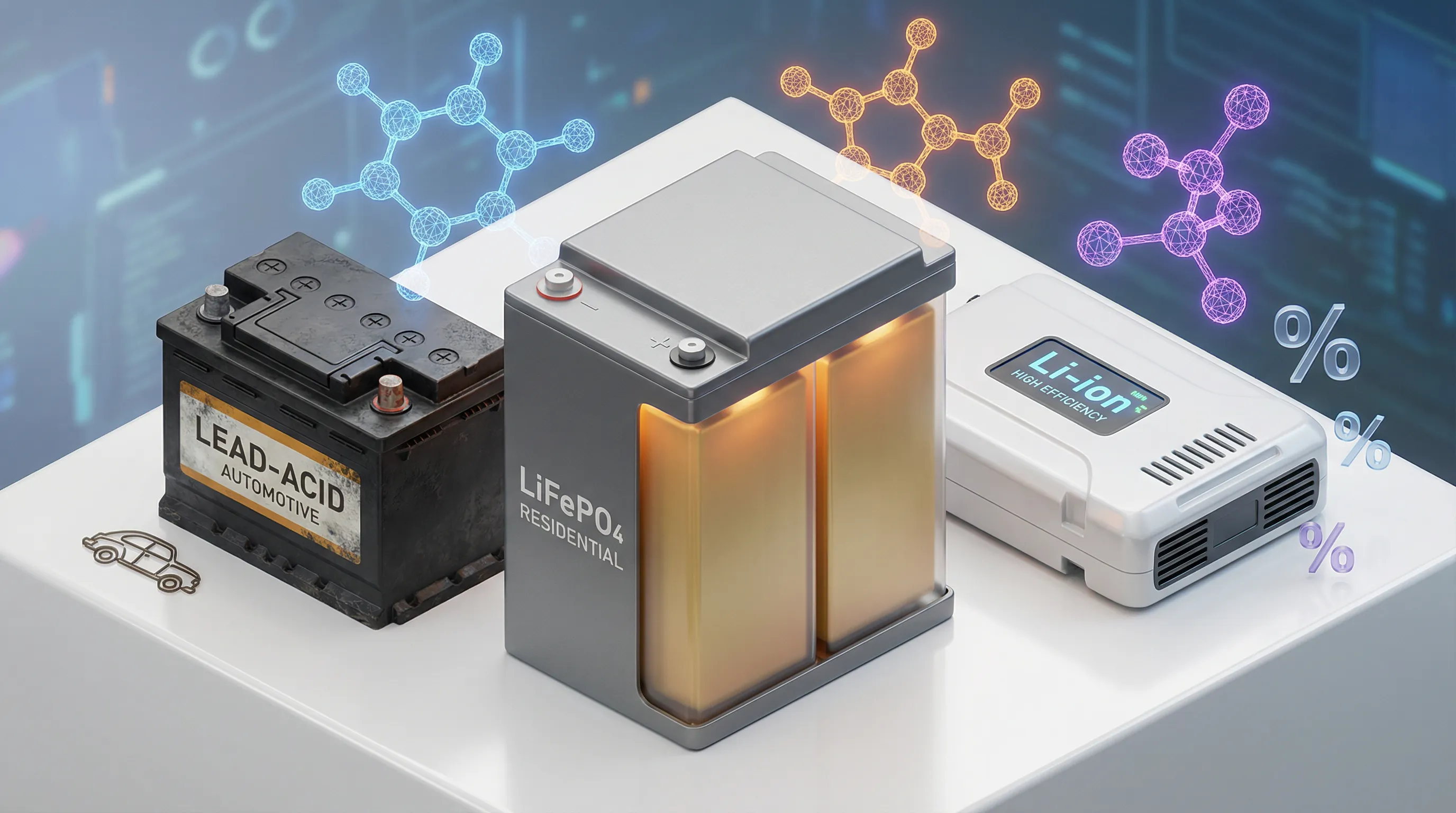
Not all batteries are created equal, and choosing the right chemistry for your application can make the difference between a system that delivers decades of reliable service and one that disappoints.
Lithium-ion technology dominates the current market, and for good reason. These batteries offer unmatched energy density, meaning they pack more power into less space, and impressive efficiency, typically converting 90-95% of input energy back into usable electricity. But "lithium-ion" is actually an umbrella term covering several distinct chemistries, each with unique characteristics.
Lithium Iron Phosphate (LiFePO4) Batteries
Lithium Iron Phosphate (LiFePO4 or LFP) batteries have become the gold standard for modern residential and commercial BESS installations, and it's easy to see why. Unlike other lithium chemistries, LiFePO4 cells are inherently heat-tolerant and thermally stable, dramatically reducing fire risk even under extreme conditions or abuse. This makes them ideal for installations in homes, garages, and businesses where safety can't be compromised.
LFP batteries also deliver exceptional cycle life, often 3,000 to 5,000 full charge-discharge cycles or more, translating to 10-15+ years of daily use. They maintain stable performance across a wide temperature range and handle high discharge rates without degradation. While they offer slightly lower energy density than some other lithium chemistries, the trade-off in safety, longevity, and reliability makes them the preferred choice for energy independence applications. Many industry leaders, including those who've been perfecting BESS since 2010, have built their entire product lines around LiFePO4 technology precisely because it balances performance with peace of mind.
Lithium-Ion vs. Lead-Acid Battery Storage
Lead-acid batteries, the same technology that's powered cars for over a century, still have a place in certain energy storage applications, but they're increasingly being phased out in favor of lithium-ion solutions.
The advantages of lithium-ion are compelling: they offer 2-3 times the energy density, meaning you need far less physical space to store the same amount of power. Efficiency is another major differentiator, lithium systems waste less energy as heat during charging and discharging. Perhaps most importantly, lithium-ion batteries can handle 3-5 times as many charge cycles as lead-acid before capacity degrades significantly, making their higher upfront cost a better long-term investment.
That said, lead-acid batteries aren't obsolete. They have lower initial costs, well-understood maintenance procedures, and can suit applications where weight and space aren't constraints and where long, slow discharge cycles (rather than frequent cycling) are the norm. Some off-grid installations still use flooded lead-acid banks, though even these are increasingly being retrofitted with lithium alternatives.
Other technologies like sodium-sulfur and flow batteries serve niche roles, primarily in utility-scale installations where their unique characteristics (like very long discharge duration) justify their complexity and cost. But for residential, off-grid, and most commercial applications, lithium-ion, particularly LiFePO4, has clearly won the race.
Benefits of Battery Storage for Homeowners and Businesses
The question isn't whether battery storage offers benefits, it's whether those benefits align with your specific goals and circumstances. For most people evaluating BESS in 2026, the answer is a resounding yes.
Energy Independence and Cost Savings
True energy independence means breaking free from the grid's unpredictable rate hikes and scheduled blackouts. When you install a battery storage system, especially one integrated with solar panels, you create a self-sufficient energy ecosystem. Your panels generate power during the day, your batteries store what you don't immediately use, and you draw from that stored energy at night or whenever production drops. The grid becomes a backup option rather than your primary lifeline.
The financial benefits are equally tangible. Time-of-use electricity rates, where power costs more during peak afternoon and evening hours, have become standard in many markets. With battery storage, you can charge during cheap off-peak periods (or from your solar array) and discharge during expensive peak times, potentially slashing your electricity costs by 30-50% or more. Businesses can use this same approach for peak shaving, avoiding the demand charges that often make up the largest portion of commercial electric bills.
For solar owners, battery storage solves the mismatch problem: your panels produce most when the sun's high (midday), but your highest consumption often occurs in the morning and evening. Without storage, you're forced to sell excess production back to the utility at wholesale rates, then buy it back at retail prices when you need it. Batteries let you keep and use every kilowatt-hour you generate, maximizing your solar investment's return.
Reliable Backup Power During Outages
Power outages aren't just inconveniences anymore, they're genuine threats to health, safety, and business continuity. Whether caused by aging grid infrastructure, extreme weather, planned safety shutoffs, or grid instability, blackouts are becoming more frequent and longer-lasting across the United States.
A properly configured battery storage system provides automatic backup power that kicks in within milliseconds of grid failure. Your lights stay on, your refrigerator keeps running, your internet connection (and that crucial work-from-home setup) remains active, and critical medical equipment continues operating without interruption. Unlike gas generators that require manual starting, refueling, and maintenance, not to mention producing noise and emissions, battery systems operate silently, cleanly, and automatically.
For businesses, backup power means avoiding the devastating costs of downtime. A restaurant doesn't lose a refrigerator full of inventory. A retail store keeps transactions flowing. A professional office maintains productivity. The peace of mind alone is often worth the investment, but when you factor in avoided losses during even a single major outage, the ROI becomes crystal clear.
Battery Storage Applications and Use Cases
Battery storage isn't one-size-fits-all, different applications demand different configurations, capacities, and features. Understanding where your needs fit helps you select the right system from the start.
Residential Solar Integration
Pairing battery storage with rooftop solar creates what's often called a "solar-plus-storage" system, and it's become the fastest-growing segment of the residential energy market. This integration allows homeowners to maximize solar self-consumption, storing daytime production for evening use rather than exporting it to the grid for minimal compensation.
Modern systems use intelligent energy management software that learns your consumption patterns and optimizes when to charge, discharge, and interact with the grid. Some advanced setups can even predict weather patterns and adjust charging schedules accordingly, topping off before a forecasted storm, for instance.
The beauty of solar integration is that the same battery provides both economic benefits (through self-consumption and TOU arbitrage) and resilience (backup power during outages). You're not choosing between savings and security, you get both.
Off-Grid and Remote Property Solutions
For properties beyond the reach of utility lines, mountain cabins, rural homesteads, remote communication towers, agricultural operations, battery storage isn't just beneficial, it's essential. Off-grid systems typically combine solar panels (and sometimes wind or micro-hydro generation) with substantial battery banks to provide 24/7 power without any grid connection.
These applications demand robust, reliable batteries capable of deep daily cycling, often in challenging environmental conditions. LiFePO4 chemistry excels here, offering the cycle life and temperature tolerance that off-grid living demands. Systems often include generator backup for extended cloudy periods, but the batteries do the heavy lifting day-to-day, eliminating the noise, fuel costs, and maintenance headaches of running generators constantly.
Off-grid storage systems have benefited enormously from advances pioneered for grid-tied applications. What once required massive banks of flooded lead-acid batteries demanding weekly maintenance can now be accomplished with compact, sealed lithium systems that run for years without intervention.
Commercial and Business Energy Storage
Businesses face unique energy challenges, demand charges, power quality issues, backup requirements for critical operations, and increasingly, sustainability mandates. Commercial BESS installations address all of these simultaneously.
Peak shaving is the killer app for many businesses: by discharging batteries during high-demand periods, companies can dramatically reduce or eliminate demand charges that can account for 30-70% of total electricity costs. A manufacturing facility might use stored energy to smooth out the power spikes when large equipment cycles on. A retail chain might deploy batteries across multiple locations to reduce each store's peak draw.
Commercial systems also provide power quality benefits, conditioning incoming electricity to protect sensitive equipment from voltage sags, surges, and harmonics that can cause failures and downtime. And for businesses where continuity is critical, data centers, medical facilities, emergency services, battery storage offers cleaner, quieter, more reliable backup than traditional diesel generators, often with the ability to integrate seamlessly with existing backup infrastructure.
Choosing the Right Battery Storage System
With dozens of manufacturers and hundreds of models on the market, selecting the right battery storage system can feel overwhelming. Focus on a few key factors and the decision becomes much clearer.
Capacity, Power Output, and Sizing Considerations
Two specs matter most: energy capacity (measured in kilowatt-hours, or kWh) and power output (measured in kilowatts, or kW). They're related but distinct, and both must match your needs.
Energy capacity determines how long your system can run. A 10 kWh battery storing 10 kWh of energy might power essential loads for 5-10 hours, depending on your consumption rate. Calculate your needs by identifying critical loads (refrigerator, lights, internet, medical equipment, HVAC, etc.) and estimating their combined hourly consumption. Most households find that 10-20 kWh covers essential needs through a typical overnight period or day-long outage. Larger homes or those seeking full-home backup often opt for 20-40+ kWh systems, sometimes achieved by stacking multiple battery modules.
Power output determines how many devices you can run simultaneously. A system might offer 5 kW continuous output and 7 kW peak, meaning it can handle a sustained 5 kW load (perhaps running your fridge, a few lights, internet, and some outlets) with brief capability to handle higher surge demands when motors start or pumps cycle. If you want to run central air conditioning, electric water heaters, or other heavy loads during an outage, you'll need higher power output ratings.
Don't forget usable vs. total capacity. Most lithium systems allow you to use 90-100% of rated capacity, while some reserve a buffer to extend lifespan. Always confirm usable capacity when comparing systems.
Working with experienced installers, particularly those who've been in the energy storage business since the technology's early days, ensures accurate sizing based on your actual usage patterns, goals, and budget. They'll analyze your utility bills, assess your panel capacity, and recommend a configuration that matches your needs without oversizing (and overspending).
Safety Standards and Certifications
Battery storage systems store significant amounts of energy, and while modern systems are remarkably safe, not all manufacturers maintain the same standards. Look for units that carry UL certification (particularly UL 9540, the safety standard specifically for energy storage systems) and UL 1973 for battery modules. These certifications mean the system has undergone rigorous third-party testing for fire safety, electrical safety, and proper functionality.
A quality BMS is your first line of defense, constantly monitoring for conditions that could lead to thermal runaway or other failures. Advanced systems include multiple layers of protection: cell-level monitoring, temperature sensors throughout the battery pack, automatic disconnects, and sometimes even integrated fire suppression.
Installation location matters too. Many jurisdictions require batteries to be installed in garages, exterior enclosures, or dedicated spaces with proper ventilation and clearances. Your installer should be intimately familiar with local codes and best practices, another reason to choose experienced professionals with a proven track record rather than whoever offers the lowest bid.
Installation and Maintenance Requirements
Professional installation isn't just recommended for battery storage systems, it's essential. These systems involve high-voltage DC circuits, grid interconnection, complex programming, and safety considerations that go far beyond typical home improvement projects.
A qualified installer will assess your electrical panel, ensure adequate space and proper environmental conditions, obtain necessary permits, coordinate utility interconnection approvals, configure the energy management system to match your goals, and conduct thorough commissioning tests before handing over the system. Installation typically takes 1-2 days for residential systems, longer for commercial projects.
The permitting process varies by jurisdiction but generally includes electrical permits, building permits for structural modifications if needed, and utility interconnection agreements. Experienced installers handle this paperwork as part of their service, navigating the sometimes-Byzantine approval processes that vary wildly from one utility or municipality to another.
Once installed, modern battery storage systems are remarkably low-maintenance, especially LiFePO4-based units. There's no watering, no terminal cleaning, no equalization charging. Most systems simply need an annual inspection to verify connections remain tight, check for any physical damage or environmental changes, confirm firmware is current, and review system performance data.
Many manufacturers offer remote monitoring through smartphone apps or web portals, letting you track energy flows, state of charge, and system health in real time. This connectivity also enables proactive service, your installer or the manufacturer can often identify and address potential issues remotely before they become problems. Look for systems backed by comprehensive warranties (10+ years is standard for quality products) and manufacturers that offer 24/7 technical support, not just business-hours email responses.
The Future of Battery Storage Technology
If you think battery storage is impressive now, you haven't seen anything yet. The technology is advancing at a breakneck pace, driven by massive investment, intense competition, and urgent climate demands.
Hybrid systems combining batteries with ultracapacitors (also called supercapacitors) are beginning to appear in commercial applications. Ultracapacitors can't store much energy, but they excel at rapid charge-discharge cycles, perfect for smoothing out brief power fluctuations or providing intense bursts of power. Paired with batteries that handle longer-duration storage, these hybrid configurations can extend system life while improving overall efficiency and performance.
Battery chemistry research continues to push boundaries. Solid-state batteries, replacing liquid electrolytes with solid materials, promise higher energy density, improved safety, and potentially lower costs once manufacturing scales up. Sodium-ion batteries, using abundant sodium instead of scarce lithium, could democratize access to energy storage in regions where lithium supply chains are limited. Each chemistry advance trickles down to residential and commercial products within a few years of laboratory proof-of-concept.
Capacity and lifespan improvements arrive with nearly every product generation. Systems that offered 3,000 cycles five years ago now deliver 5,000-6,000. Batteries that degraded 20% after a decade now maintain 80%+ capacity after 15 years. And costs continue to fall, residential battery storage prices have dropped 50-70% since 2015 and show no signs of stabilizing.
Software and integration will matter as much as hardware. Future BESS units will participate in virtual power plants, where thousands of distributed batteries coordinate to support grid stability in exchange for payments to owners. They'll integrate with electric vehicle charging, home automation systems, and increasingly sophisticated AI that predicts your needs and optimizes accordingly. The battery in your garage or basement may become a revenue-generating asset, not just an expense.
Regulatory and incentive environments are evolving too. Federal investment tax credits, state rebates, and utility programs increasingly recognize the grid-support value of distributed storage. As these incentives expand and insurance companies begin offering premium discounts for homes with backup power, the economics of battery storage will become even more compelling.
Conclusion
Battery storage has crossed the threshold from emerging technology to proven solution. Whether you're motivated by energy independence, cost savings, backup security, environmental responsibility, or all of the above, there's never been a better time to invest in a BESS.
The technology has matured, particularly LiFePO4 systems from manufacturers with over a decade of real-world deployment experience. Costs have fallen to where payback periods make financial sense for most applications. And the benefits extend beyond simple economics to encompass resilience, autonomy, and peace of mind that's hard to quantify but impossible to ignore once you've experienced your first grid outage while your neighbors sit in the dark.
Start by honestly assessing your goals and needs. Calculate your critical loads and desired backup duration. Explore your solar potential if you haven't already. Then connect with experienced installers who can translate your goals into a properly sized, professionally installed system backed by solid warranties and ongoing support.
The future of energy is distributed, renewable, and resilient, and battery storage is the technology that makes it all possible. Your path to energy independence starts with understanding the options, and now you've got the knowledge to take that first step confidently.
Frequently Asked Questions About Battery Storage
How does battery storage work with solar panels?
Battery storage captures excess solar energy generated during the day and stores it in rechargeable cells. The system converts AC grid electricity to DC chemical energy for storage, then reverses the process to deliver AC power when you need it—at night, during outages, or during peak-rate hours. This integration maximizes your solar investment by letting you use every kilowatt-hour generated.
What size battery storage system do I need for my home?
Size depends on two factors: energy capacity (kWh) for duration and power output (kW) for simultaneous load. Most homes need 10-20 kWh for essential overnight backup; larger homes may want 20-40+ kWh. Calculate critical loads (refrigerator, lights, internet, medical equipment) and their combined hourly consumption, then work with an experienced installer to right-size your system.
What is the difference between lithium-ion and lead-acid battery storage?
Lithium-ion batteries offer 2-3 times higher energy density, superior efficiency, and 3-5 times more charge cycles than lead-acid alternatives. While lithium has higher upfront costs, its longevity and performance make it a better long-term investment for most applications. Lead-acid may suit low-cost, minimal-cycling applications, but lithium-ion dominates modern battery storage installations.
Can battery storage reduce my electricity costs?
Yes, battery storage significantly cuts costs through time-of-use arbitrage—charging during cheap off-peak hours and discharging during expensive peak times can slash electricity bills by 30-50% or more. For businesses, battery storage enables peak shaving to eliminate demand charges, which often account for 30-70% of total electric costs.
What certifications should I look for in a battery storage system?
Choose systems with UL 9540 certification (energy storage safety standard) and UL 1973 for battery modules. These third-party certifications verify rigorous testing for fire safety, electrical safety, and proper functionality. A quality Battery Management System with multiple protection layers—cell monitoring, temperature sensors, automatic disconnects—is essential for safe operation.
How long does a battery storage system last?
Modern LiFePO4 battery systems typically last 10-15+ years with proper maintenance, enduring 3,000-5,000 full charge-discharge cycles or more. Most quality batteries maintain 80%+ capacity after 15 years. Professional installation, annual inspections, and remote monitoring help maximize lifespan and system health. Look for warranties of 10+ years when selecting a system.